
Losing weight can be a powerful and positive change, but for some patients, it also brings an unexpected concern: the face starts to look older, thinner, hollow, or tired. Many people who search for Ozempic face or Wegovy face are not really worried about the medication itself; they are trying to understand why their reflection looks different after significant weight loss, especially when the body feels healthier and more balanced.
In my practice, I explain that Ozempic face is not a formal medical diagnosis, but a popular term used to describe certain facial changes after weight loss. These changes may include loss of facial fat, reduced projection in the cheeks, skin laxity, and descent of the facial tissues, which can create a faster-looking aging effect. As a plastic surgeon for Ozempic face, my approach is not to treat every patient the same way, but to evaluate whether the face needs volume restoration, tissue repositioning, improvement in skin quality, or a carefully planned combination of these options.

What Is Ozempic Face and Why Are Patients Talking About It? Ozempic Face Is a Popular Term, not a Diagnosis
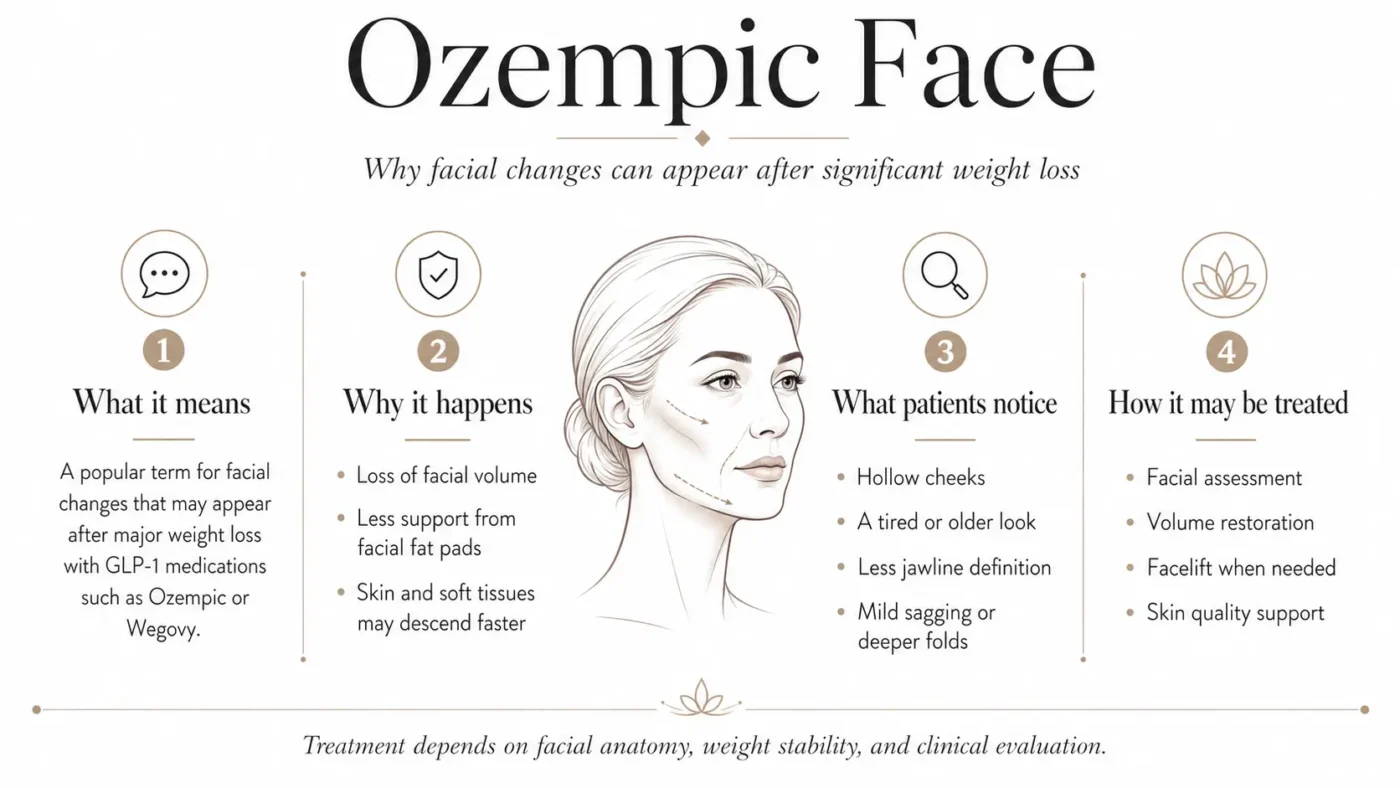
When patients ask me about Ozempic face, they are usually referring to a group of facial changes that may appear after significant weight loss with GLP-1 medications. The same concern is often searched online as Wegovy face, semaglutide face, or GLP-1 face, but the idea behind these terms is very similar: the body loses weight, and the face may begin to look thinner, less supported, or more aged than expected.
It is important to be very clear about this: Ozempic face is not a formal medical diagnosis. It is a popular expression used to describe visible changes in the face after weight loss. The medication does not “attack” the face. What usually happens is that, as the body loses fat, the face can also lose part of its natural volume. At the same time, the skin and soft tissues may not adapt at the same pace, especially when the weight loss is rapid or significant.

Key medical idea:
The issue is not only “fat loss.” In many patients, the real concern is the combination of less facial volume, weaker support, skin laxity, and tissue descent.
Why the Face Can Look Older After Major Weight Loss
The face has different fat compartments that help create support, contour, and youthful volume. These facial fat pads contribute to cheek projection, softness around the midface, and a more defined transition between the face and jawline. When there is facial volume loss after weight loss, those compartments can lose projection and, in some cases, descend more noticeably.
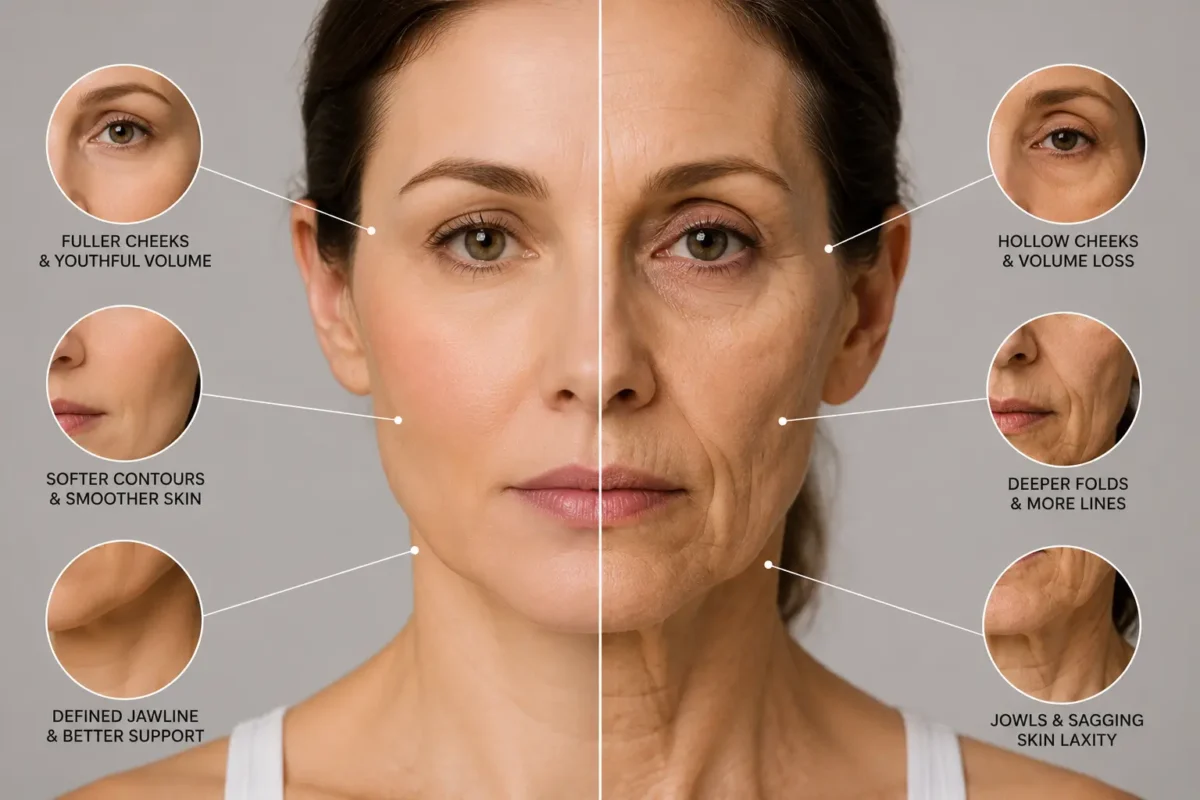
This is why some patients tell me: “I lost weight, but my face looks tired,” or “My body looks better, but my face looks older.” From a surgical point of view, that concern makes sense. When the facial fat pads lose volume, they may no longer provide the same anterior support, and the tissues can shift downward more quickly, creating visible signs such as:
✔ Hollow or flatter cheeks
✔ A tired or drawn appearance
✔ Deeper nasolabial folds
✔ Less jawline definition
✔ Early jowls or lower face heaviness
✔ Face sagging after weight loss
For this reason, treating Ozempic face or semaglutide face is not about adding volume randomly. The key is to understand what changed first: did the patient mainly lose facial volume, did the tissues descend, did the skin lose firmness, or are all these factors present together? That distinction is what allows me to recommend a more precise and natural-looking facial rejuvenation plan.
What Happens to Facial Fat Pads After Ozempic or Wegovy Weight Loss?
One of the most common concerns I hear from patients is: “My body looks better, but my face looks older.” From an anatomical point of view, this usually has an explanation. The face has different facial fat pads that provide support, softness, cheek projection, and balance. When a patient loses a significant amount of weight, those fat compartments can also lose volume.
When this happens, the face may look flatter, thinner, or more tired. Patients often describe it in very personal ways: “my cheeks look hollow,” “my face looks older,” or “I look tired even when I feel well.” These descriptions are often related to facial fat loss after weight loss, especially when the midface loses part of its natural support.
A simple way to understand it is:
✔ Less cheek volume can make the face look hollow
✔ Less support can make facial folds look deeper
✔ Less softness can make the face appear more tired
✔ Less balance between the midface and lower face can make aging signs more visible
This is why hollow cheeks after weight loss should not be treated only as a cosmetic detail. In many cases, they are part of a broader facial change that includes volume loss, tissue movement, and skin adaptation.
Tissue Descent: Why Sagging Can Become More Noticeable
In my consultations, I also explain that the problem is not always just “loss of fat.” When the facial fat pads lose volume, they may also lose forward projection. As that support decreases, the soft tissues can descend more noticeably, especially in the midface, lower face, and neck.
That descent can make certain signs more visible: jowls, deeper nasolabial folds, lower face heaviness, less jawline definition, or neck laxity. This is an important point because it changes the treatment plan. If the tissues have descended, simply adding volume may not be enough.
Clinical perspective:
When the main issue is tissue descent, the face may need repositioning, not just filling. This is why some patients who come looking for fillers may need a more complete facial rejuvenation plan. Fillers can help in selected cases, but they cannot reposition descended tissues in the same way that a surgical lifting procedure can.
Skin Quality: Why the Skin May Look Less Firm
Another factor I evaluate is skin quality. After significant weight loss, the skin does not always contract at the same speed as the body changes. Some patients notice fine lines, thinner-looking skin, texture changes, or reduced firmness. This is what many people describe as skin laxity after weight loss.
The skin has its own behavior. It depends on age, genetics, sun exposure, collagen quality, previous weight changes, and how fast the weight loss happened. For that reason, two patients can lose a similar amount of weight and still have very different facial results.
When skin quality is part of the problem, I may consider treatments that support biostimulation or resurfacing, such as Fotona, depending on the case. But I always make one thing clear: skin treatments can improve texture and firmness in selected patients, but they do not replace lifting procedures when sagging is significant.
Is Ozempic Face the Same for Every Patient? The Speed and Amount of Weight Loss Matter
No. Ozempic face is not the same for every patient. Some people lose weight and notice only a subtle change in their face. Others experience more visible facial thinning, sagging, or hollowing. The speed and amount of weight loss are important factors.
When weight loss is rapid or significant, facial volume loss may become more noticeable because the skin and soft tissues need time to adapt. Patients who lose a larger amount of weight may see more changes in the midface, lower face, and neck.
This does not mean that every patient using Ozempic, Wegovy, or another GLP-1 medication will develop the same facial changes. It means that when the face does change, we need to understand why before deciding on treatment.
Age, Skin Elasticity and Facial Anatomy Also Influence the Result
Age and skin elasticity play a major role. Younger skin may adapt better after weight loss, while mature skin may show more laxity. But age is not the only factor. A patient’s natural facial anatomy also matters.
For example, patients with naturally thin faces may notice hollowing earlier. Patients who already had some laxity before losing weight may notice more sagging than volume loss. Others may have a combination of both: less facial volume and more visible descent of the tissues.
Here is how I usually think about it during evaluation:
| What I notice in the face | What may be happening |
|---|---|
| Hollow cheeks or temples | Volume loss may be dominant |
| Jowls or lower face heaviness | Tissue descent may be dominant |
| Fine lines and loose texture | Skin laxity may be present |
| Hollowing + sagging + texture changes | A combined plan may be needed |
Some Patients Need Volume, Others Need Lifting
This is one of the most important ideas in Ozempic face treatment or Wegovy face treatment: not every patient needs the same solution.
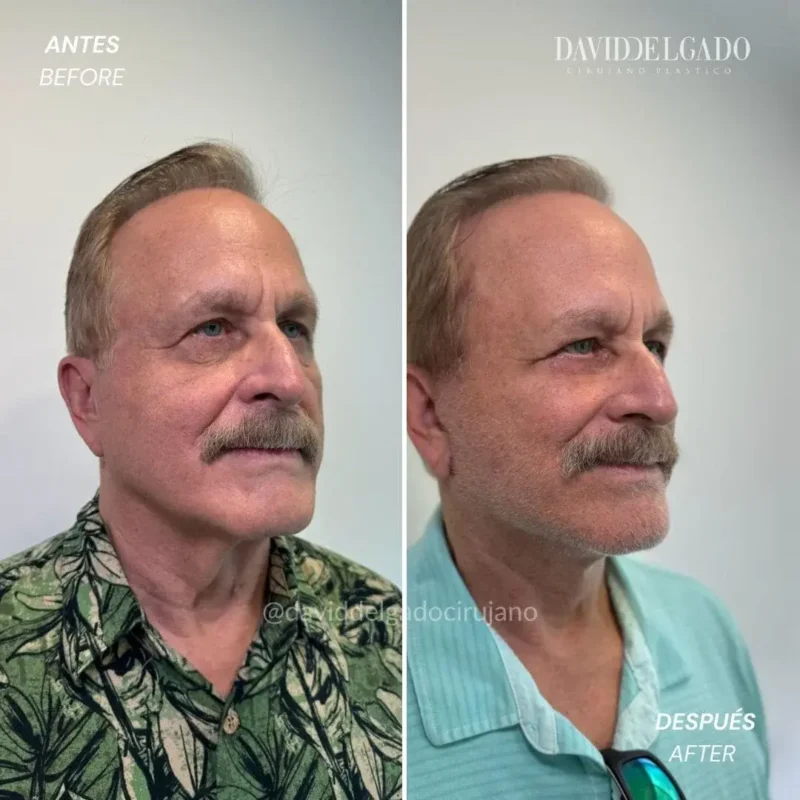
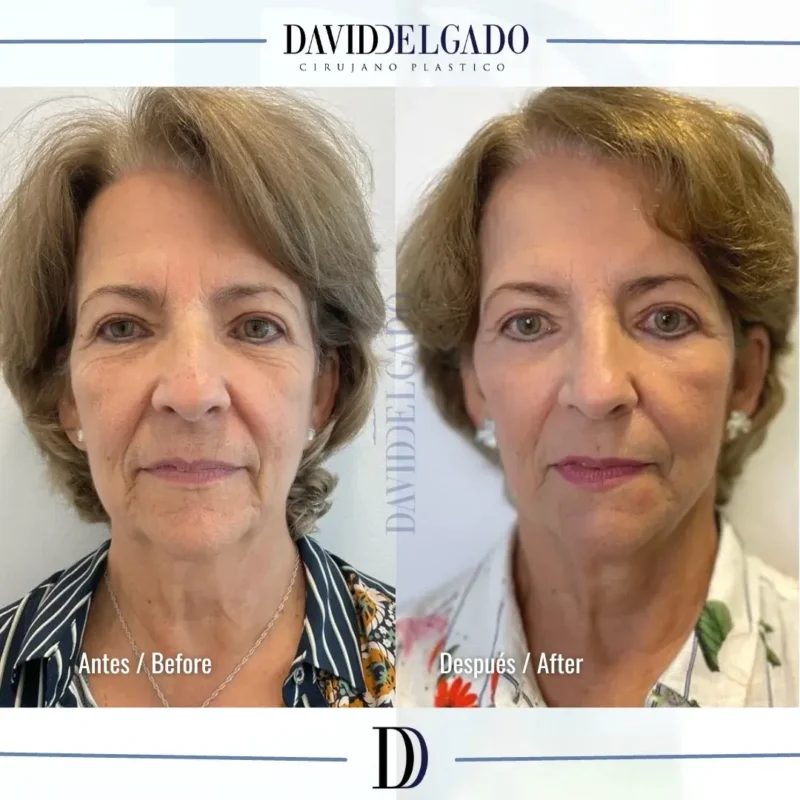
If the main concern is volume loss, treatment may involve restoring volume with fat grafting or fillers, depending on the case. If the main concern is tissue descent, the patient may need a facelift or another facial lifting procedure. And in many cases, the best approach is a combination: lifting the tissues, restoring volume, and improving skin quality.
My goal with facial rejuvenation after weight loss is not to make the face look overdone. The goal is to restore support, proportion, and natural expression in a way that fits the patient’s anatomy.
How Can a Plastic Surgeon Treat Ozempic Face? The First Step Is Understanding What Changed
As an Ozempic face plastic surgeon, the first thing I do is not decide on a procedure. The first step is to understand what has changed in the patient’s face. I evaluate volume, skin quality, facial support, tissue descent, jawline definition, and the relationship between the midface, lower face, and neck.
This evaluation is essential because the goal is not to fill the face randomly. When too much volume is added without understanding the anatomy, the result can look heavy or unnatural. A good treatment plan should restore facial balance, not simply replace every area that looks thinner.
There is also medical literature that supports this way of thinking. Cleveland Clinic explains that the term “Ozempic face” is commonly used to describe facial volume loss associated with rapid weight loss, often creating a more hollow or aged appearance. A 2025 systematic review in plastic surgery literature also discusses how facial volume changes related to “Ozempic face” may be addressed with options such as dermal fillers or fat grafting in areas like the temples, tear troughs, cheeks, and nasolabial folds.
Volume Restoration for Hollow Areas
When the main issue is volume loss, restoring volume can help bring back softness and support to the face. This may be useful in areas such as the cheeks, temples, under-eye region, or deeper facial folds.
Depending on the patient, volume restoration may involve dermal fillers or fat grafting. Fillers can be useful in selected cases, especially when the volume loss is mild or localized. Fat grafting may be considered when we want to restore volume using the patient’s own fat, particularly as part of a more complete facial rejuvenation plan.
The key is proportion. A natural result does not come from adding more volume. It comes from placing the right amount in the right areas, according to the patient’s anatomy.
Lifting Procedures for Sagging and Tissue Descent
In other patients, the main problem is not only hollowing. When the facial fat pads descend, restoring volume alone may not correct the facial aging pattern. In these cases, a facelift or another facial lifting procedure may be more appropriate.
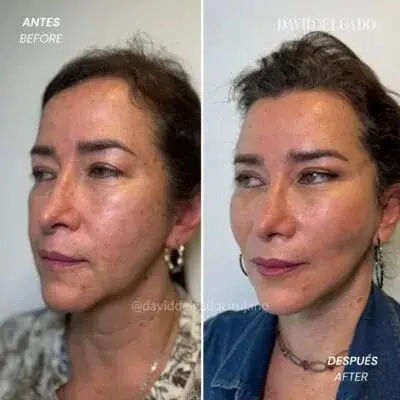
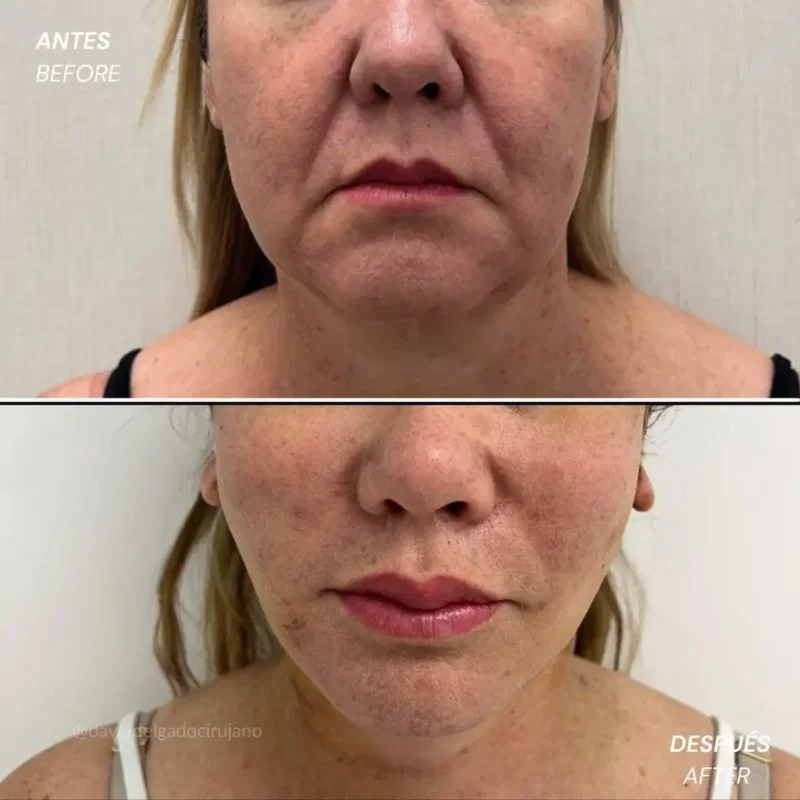
A facelift after weight loss can help reposition descended tissues and improve facial definition, especially when the patient has jowls, lower face sagging, neck laxity, or loss of jawline contour. This is why some patients searching for a plastic surgeon for Ozempic face may need more than non-surgical treatment.
A facelift for Ozempic face does not mean changing the patient’s identity. When it is well planned, the objective is to restore support, improve definition, and maintain a natural expression.
Schedule a consultation here
Facelift for Ozempic Face: When Lifting May Be the Best Option
Fillers can be very helpful when the main issue is mild volume loss. However, they have limits. Fillers cannot truly reposition descended tissues, and they cannot correct significant sagging in the lower face or neck.
In patients with sagging, too much filler can sometimes create a heavier or less natural look. Instead of making the face look younger, it can make it look swollen or overfilled. This is why I always evaluate whether the problem is hollowing, descent, or both.
When the issue is structural descent, a facelift may be a better option than trying to correct everything with volume.
Restoring Definition Without Overfilling the Face
One of the main goals of a facelift in this context is to restore definition without overfilling the face. After significant weight loss, patients often want to look refreshed, not different. They want their face to look aligned with the way they feel after improving their body.
A surgical lifting plan can help reposition the tissues, improve the lower face, define the jawline, and address the neck when clinically indicated. In selected patients, I may also combine lifting with volume restoration to avoid a tight or depleted look.
What I want patients to understand:
A natural result usually comes from correcting the right layer of the problem: volume when volume is missing, lifting when tissues have descended, and skin treatments when skin quality needs support.
Why Facial Rejuvenation Should Be Planned After Weight Stabilization
Timing matters. When a patient is still actively losing weight, the face may continue to change. For that reason, it is usually better to evaluate facial rejuvenation after weight loss when the weight is relatively stable.
This does not mean every patient must wait the same amount of time. It means that the surgical plan should be made with enough stability to reduce the risk of future facial changes affecting the result. A personalized consultation helps define the right moment based on the patient’s weight history, facial anatomy, skin quality, and goals.
When I see sagging face after weight loss, I do not only ask what the patient wants to improve. I also ask where they are in their weight loss process, how stable their weight has been, and what kind of result would look natural for their face.
Fat Grafting, Microfat and Nanofat for Ozempic Face
When I evaluate a patient with Ozempic face, one of the first questions I ask is whether the face has mainly lost volume or whether the tissues have also descended. If the face looks hollow, depleted, or less youthful after weight loss, volume restoration may be an important part of the treatment plan.
One option I often discuss is fat grafting for Ozempic face. This technique uses the patient’s own fat, usually taken from another area of the body, to restore volume in selected facial areas. It can be especially useful when the cheeks, temples, or other regions have lost support after significant weight loss.
However, the goal is not to simply “add fat” to the face. Volume must be restored carefully. If too much volume is placed, or if it is placed in the wrong areas, the result can look exaggerated or unnatural. My objective is to restore balance, softness, and facial harmony while respecting the patient’s natural features.
My surgical principle:
The best facial rejuvenation plan is not the one that adds the most volume. It is the one that restores the right support in the right areas.
Microfat for Structural Volume Restoration
Microfat transfer face techniques can be useful when the face needs structural volume restoration. In simple terms, microfat is processed fat that can be placed in areas where the face has lost support, depending on the patient’s anatomy and treatment goals.
In patients with facial fat grafting after weight loss, microfat may be considered for areas such as:
✔ Cheeks that have lost projection
✔ Temples that look hollow
✔ Selected areas of facial depletion
✔ Regions where volume loss affects facial balance
I usually explain it this way: microfat is not meant to change the face into something different. It is used to help restore what weight loss may have reduced: support, contour, and a more rested facial appearance.
This is why microfat can be part of a natural facial rejuvenation plan, especially when the patient does not want an overfilled look and prefers a result that feels more aligned with their own facial structure.
Nanofat for Skin Quality and Delicate Areas
Nanofat is different from microfat. A nanofat face treatment involves a more refined fat-processing technique that may be used in selected cases to support skin quality and delicate areas. I do not present nanofat as a magic solution or as a guaranteed way to regenerate the skin, because every patient responds differently.
In my practice, nanofat may be considered as a complement when the concern is not only volume loss, but also skin quality. Some patients notice that their skin looks thinner, less firm, or more tired after major weight loss. In those cases, nanofat can be part of a broader strategy, especially when combined with volume restoration, facial lifting, or skin-focused technologies.
The important point is this: microfat and nanofat are not interchangeable. They have different purposes. Microfat is usually more related to structural volume restoration, while nanofat may be considered when I want to support skin quality in selected areas.
Skin Quality After Weight Loss: Why Fotona May Be Part of the Plan
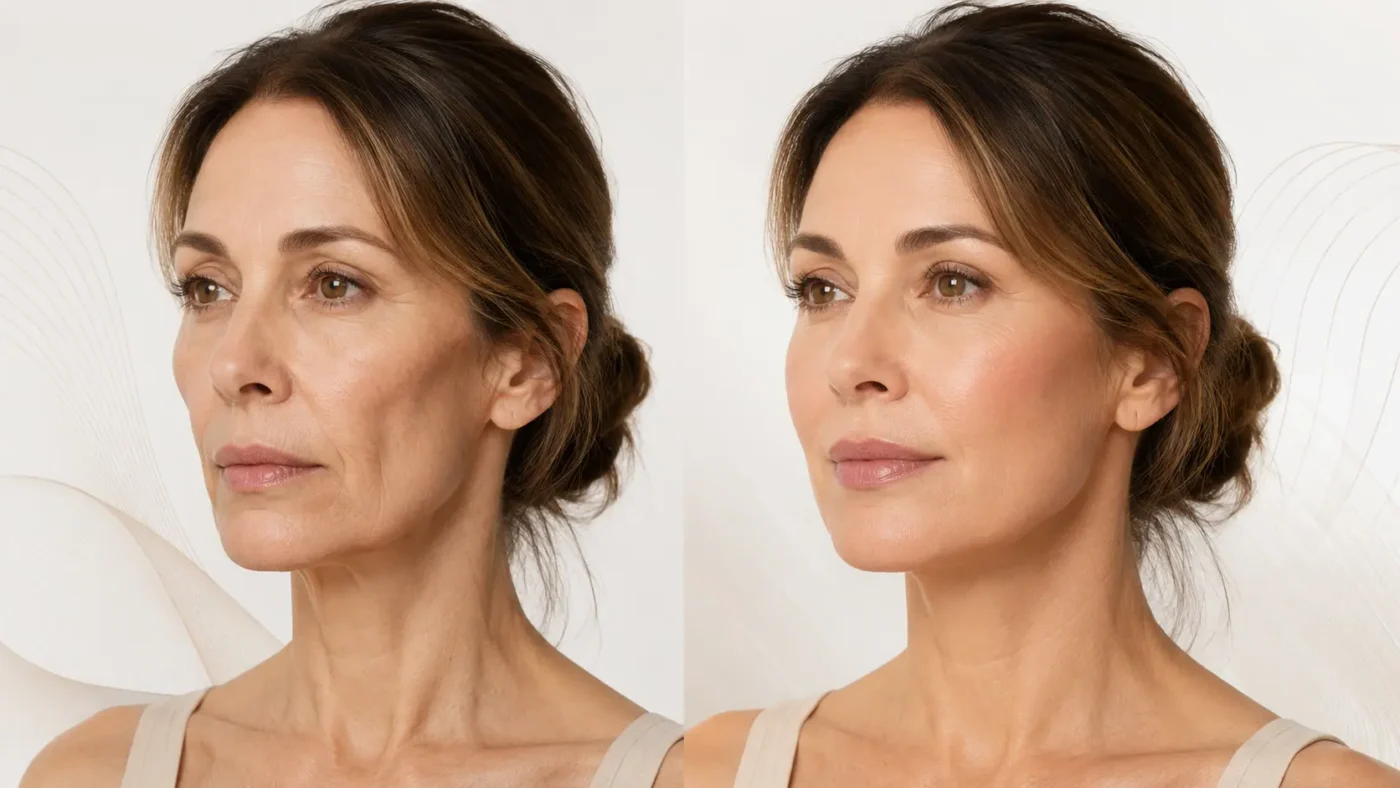
Not every patient with GLP-1 facial volume loss needs only volume restoration. Some patients also notice that the skin itself has changed. They may describe thinner skin, fine lines, texture changes, reduced firmness, or a less fresh appearance.
This is common after major weight loss because the skin does not always contract at the same speed as the body changes. When there is skin laxity after weight loss, the face may look older not only because it has lost volume, but also because the skin has less support and less firmness.
When I evaluate these patients, I separate the problem into three levels:
✔ Structure: Has the tissue descended?
✔ Volume: Has the face lost support or projection?
✔ Skin quality: Is there laxity, texture change, or reduced firmness?
This distinction is very important because each level may need a different type of treatment.
Fotona for Biostimulation and Resurfacing
In selected patients, I may include Fotona as part of the plan. Fotona facial rejuvenation can be used to support skin quality through treatments that stimulate the skin response and improve surface appearance. In simple terms, this may help with biostimulation and resurfacing when the patient is a good candidate.
Biostimulation means encouraging the skin to improve its own quality over time. Resurfacing refers to working on the surface of the skin, especially when there are texture changes, fine lines, or irregularities. I always explain that these treatments are not a substitute for surgery when the main issue is significant sagging.
Important clarification:
Fotona can be part of a skin-quality strategy, but it does not replace a facelift when the deeper tissues have descended.
This is why I do not recommend the same treatment for every patient. A person with early skin changes may benefit from a skin-focused plan, while another patient with jowls, lower face heaviness, and neck laxity may need a surgical approach.
Combining Surgery, Fat Grafting and Skin Treatments
Many Ozempic face cases are not solved with one technique. Some patients need lifting, others need volume restoration, and some need improvement in skin quality. In many cases, the most natural result comes from combining these strategies carefully.
For example, a patient with facial hollowing may benefit from fat grafting. A patient with tissue descent may need a facelift or neck lift. A patient with fine lines or texture changes may benefit from skin resurfacing after weight loss. And a patient with all these concerns may need a combined plan.
That does not mean doing more procedures just because they are available. It means choosing the right tools based on anatomy, clinical evaluation, and the patient’s expectations.
The face should not look overfilled. It should not look pulled. It should look balanced, rested, and consistent with the patient’s natural identity.
Ozempic Face Treatment Options: Surgical vs. Non-Surgical Approaches
Some patients who ask about Ozempic face treatment or Wegovy face treatment are not ready for surgery, and in mild cases, that may be reasonable. If the main concern is early volume loss, mild skin changes, or subtle hollowing, non-surgical options may help improve appearance.
These options may include dermal fillers for Ozempic face, skin treatments, biostimulation, or laser-based technologies, depending on the case. Fillers can be useful when the patient needs conservative volume correction in specific areas.
However, I always explain the limits clearly. Non-surgical treatments can improve selected concerns, but they cannot reposition descended tissues in the same way surgery can. When sagging is significant, trying to correct everything with fillers may create a heavy or unnatural appearance.
When Surgery Offers a More Complete Correction
Surgery may be considered when the main problem is structural. This includes tissue descent, jowls, neck laxity, lower face heaviness, or deeper signs of facial aging after weight loss. In these cases, surgical facial rejuvenation can offer a more complete correction because it addresses the position of the tissues, not only the loss of volume.
Depending on the patient, the plan may include a facelift, neck lift, or a combination of facial lifting procedures. In some cases, I also combine surgery with fat grafting to restore volume in areas that look depleted.
A surgical plan is not about making the face look different. It is about restoring support, improving definition, and creating a result that looks natural for that patient’s anatomy.
Why Combination Treatments Often Look More Natural
One of the most common fears patients have is looking overdone. That is why I believe the treatment plan must be balanced. Lifting without volume may look incomplete in a patient who has lost significant facial fat. Filling without lifting may look heavy in a patient whose tissues have descended.
A combined plan can address the face more harmoniously:
✔ Lifting can reposition descended tissues;
✔ Fat grafting can restore selected areas of volume loss;
✔ Skin treatments can support texture, firmness, and surface quality.
The best approach depends on what the patient needs. When the plan respects anatomy, the result tends to look more natural because each problem is treated at the correct level.
Choose Dr. David Delgado in Medellín for Your Ozempic Face Treatment
As a plastic surgeon for Ozempic face, my approach begins with understanding your anatomy, not applying the same solution to every patient. When I evaluate Ozempic face or Wegovy face, I look at facial volume, tissue descent, skin quality, facial proportion, and the way your features have changed after weight loss. Depending on your case, options such as facelift, facial lifting techniques, microfat, nanofat, or Fotona may be considered as part of a personalized plan focused on natural-looking facial rejuvenation.
My practice is in the Oviedo Medical Tower in Medellín, where I care for patients from Colombia and abroad who are looking for Ozempic face treatment Medellin, facial rejuvenation Medellin Colombia, or Ozempic face treatment in Colombia with a medical and responsible approach. My academic training at UIS and the Universidad de Antioquia, along with certifications and affiliations with SCCP, ASPS, and the Colombian Ministry of Health, support the way I make surgical decisions. When surgery is indicated, procedures are performed at Interquirófanos, a JCI-accredited clinical environment, where planning, safety protocols, and professional support are essential parts of the patient experience.

Frequently Asked Questions About Ozempic Face and Wegovy Face
What is Ozempic face?
Ozempic face is a popular term used to describe facial changes that some patients notice after significant weight loss with GLP-1 medications. It is not a formal medical diagnosis. In most cases, patients are referring to visible changes such as hollow cheeks, facial thinning, deeper folds, sagging skin, or a more tired and aged appearance. In my practice, I evaluate these changes by looking at facial volume, skin quality, tissue descent, and overall facial balance.
Is Wegovy face the same as Ozempic face?
Yes, many patients use Wegovy face and Ozempic face to describe similar facial changes after weight loss. Both terms are usually related to the way the face can change when a patient loses facial fat, especially after rapid or significant weight reduction. The important point is not the name of the medication, but understanding what happened anatomically: volume loss, skin laxity, tissue descent, or a combination of these factors.
Does Ozempic damage the face?
I would not describe it that way. The medication does not “damage” the face. What usually happens is that, as the body loses weight, the face can also lose fat and structural support. When facial fat pads lose volume, the face may look thinner, flatter, or more hollow. If the skin and soft tissues do not adapt at the same pace, sagging can become more noticeable. That is why facial changes after weight loss should be evaluated carefully instead of being blamed only on the medication.
Why do I look older after losing weight?
This is one of the most common concerns I hear. The face has fat compartments that help create cheek projection, softness, and youthful contour. After major weight loss, those compartments may lose volume and support. As a result, the cheeks can look hollow, the folds can look deeper, the jawline may become less defined, and the lower face can appear heavier. In some patients, the body looks healthier after weight loss, but the face looks more tired because it has lost volume and support.
Can Ozempic face improve without surgery?
In some patients, yes. If the changes are mild and mainly related to early volume loss or skin quality, non-surgical options may help. These can include fillers, biostimulation, laser-based treatments, or other skin-focused procedures, depending on the case. However, if there is significant sagging, jowls, neck laxity, or tissue descent, non-surgical treatments may have limitations. That is why a proper evaluation is essential before choosing an Ozempic face treatment.
When is fat grafting useful for Ozempic face?
Fat grafting for Ozempic face may be useful when the main issue is loss of volume in areas such as the cheeks, temples, under-eye region, or selected facial hollows. This technique uses the patient’s own fat to restore volume in specific areas. I may consider facial fat grafting after weight loss when the face looks depleted and needs support, but the volume must be restored with precision. The goal is not to overfill the face, but to recover balance and natural facial harmony.
What is the difference between microfat and nanofat?
Microfat and nanofat are both related to fat processing, but they are not used for the same purpose. Microfat transfer face techniques are generally used when the goal is to restore structural volume in areas that need more support, such as the cheeks or temples. Nanofat face treatment may be considered in selected cases to support skin quality or delicate areas. I explain it simply: microfat is more about volume, while nanofat is more related to skin quality, depending on the patient’s needs.
When is a facelift better than fillers for Ozempic face?
A facelift may be more appropriate when the main issue is tissue descent, not only volume loss. Fillers can help with mild or localized hollowing, but they cannot truly reposition sagging tissues. If a patient has jowls, lower face heaviness, neck laxity, or significant face sagging after weight loss, adding too much filler may create a heavy or unnatural look. In those cases, a facelift for Ozempic face may offer a more complete correction because it addresses the position of the tissues.
How long should I wait before treating Ozempic face?
Timing depends on each patient, but I usually prefer to evaluate facial rejuvenation when the patient’s weight is relatively stable. If weight loss is still active, the face may continue changing, which can affect the treatment plan. This is especially important for patients considering surgery, fat grafting, or a combined facial rejuvenation approach. During consultation, I review the patient’s weight history, current goals, facial anatomy, and skin quality before recommending the right moment.
Can international patients travel to Medellín for Ozempic face treatment?
Yes. Many patients from outside Colombia contact my team for Ozempic face treatment in Colombia or facial rejuvenation Medellin Colombia. The process can begin with an initial orientation, where photos, medical history, weight loss history, and general goals help us understand the case. However, the final treatment plan must be defined during an in-person medical evaluation. For international patients, planning is especially important because recovery time, lodging, transportation, and postoperative follow-up should be organized according to the procedure selected.
Bibliographic sources
- Cleveland Clinic. (2025, March 5). ‘Ozempic face’: What it is and how to avoid it. Cleveland Clinic Health Essentials.
- Daneshgaran, G., et al. (2025). “Ozempic Face” in Plastic Surgery: A Systematic Review of the Literature. Aesthetic Surgery Journal Open Forum.