

One of the most common concerns I hear from patients is that their neck no longer reflects how young or energetic they feel. They may notice a softer jawline, loose neck skin, vertical bands, or fullness beneath the chin—even when the rest of the face still looks relatively youthful. Many people researching a neck lift in Colombia are not yet certain they need surgery; they simply want to understand why their neck has changed and whether creams, exercises, laser treatments, or other non-surgical options can realistically improve it.
Before choosing any treatment, I believe it is essential to identify what is happening beneath the skin. A sagging neck may result from skin laxity, fat accumulation, muscle separation, genetics, weight changes, or a combination of these factors. In this guide, I will explain how to tighten neck skin, when non-surgical treatments may help, when a neck lift—also known as cervicoplasty or platysmaplasty—may be considered, and what patients should know about cost, recovery, safety, and natural-looking results in Colombia.
Why Does My Neck Look Older or Less Defined Than My Face?
The neck does not age as a single layer. When I evaluate a patient who is concerned about an aging neck or a poorly defined jawline, I look beyond the surface of the skin. The visible change may involve skin laxity, platysma muscle, fat beneath the chin, facial structure, or several of these factors at the same time.
This distinction is important because two people may appear to have a similar concern in the mirror but require completely different treatment plans. One may mainly have localized fat, while another may have excess skin and visible muscle bands. A third patient may have a combination of all three.
| What you may notice | Structure that may be involved | How it can affect the neck |
|---|---|---|
| Folds or hanging skin | Skin and supporting tissues | Softens the angle between the chin and neck |
| Vertical cords | Platysma muscle | Creates visible bands in the front of the neck |
| Fullness below the chin | Submental fat | Reduces jawline definition |
| A neck that looks heavier after weight changes | Skin, fat and volume distribution | Produces laxity or uneven contours |
| A naturally soft profile | Genetics and skeletal anatomy | May limit chin and jawline definition |
These visible concerns are commonly associated with loose skin, muscle banding, submental fat and loss of the angle between the chin and neck. For that reason, an accurate evaluation must identify which structures are contributing to appearance rather than assuming that every patient simply needs tighter skin.
Loose Skin Is Only One Part of the Problem
As the skin loses elasticity, it may no longer conform as closely to the tissues underneath. This can lead to fine folds, deeper creases or loose skin under the chin. The transition from the jawline to the neck may gradually become less defined, particularly when the skin begins to collect beneath the chin or along the lower face.
However, tightening the skin alone does not always address the complete problem. If the underlying muscle has separated or fat is contributing to fullness, treating only the surface may produce a limited or unbalanced change. In my consultations, I therefore evaluate the quality of the skin, the amount of excess tissue and how the deeper structures support the neck.
Vertical Neck Bands May Come from the Platysma Muscle
The platysma is a thin, broad muscle that extends across the front and sides of the neck. Over time, its inner borders may separate or become more visible, creating the vertical cords commonly known as platysmal bands.
Patients sometimes assume that these lines are wrinkles, but they can originate beneath the skin. They may become more noticeable when speaking, moving the neck or tightening the lower face. Depending on their severity, improving the skin alone may not be enough because the muscle itself can be contributing to the contour.
This is one of the reasons I assess the neck both at rest and during movement. Understanding how platysma behaves helps me distinguish a superficial skin concern from a structural change involving the muscle. Medical references on neck rejuvenation identify platysmal banding as one of the principal anatomical changes evaluated when planning treatment.
Fat Under the Chin Can Blur the Jawline
Submental fat is the fat located beneath the chin. Even a relatively small accumulation in this area can soften the angle between the jaw and neck, producing a double chin and loose skin appearance.
This does not occur only in people who are overweight. Genetics influence where the body stores fat, which means a person may be at a stable and healthy weight while still having fullness beneath the chin. Fat can also exist at different depths in relation to the platysma muscle, so treatment planning requires more than simply looking at the amount visible from the outside. Anatomical research describes the submental area as a distinct fat compartment that plays an important role in neck contour.
I also consider skin elasticity before determining whether fat reduction alone could be useful. When the skin has good support, reducing localized fat may improve definition in an appropriately selected patient. When there is already significant laxity, removing fat without addressing the skin may not create the contour the patient expects.
Genetics, Aging and Weight Loss Affect Every Neck Differently
There is no single age at which the neck begins to change. Genetics can influence skin quality, fat distribution, muscle anatomy, chin projection and how clearly the jawline is defined. Some patients notice changes relatively early, while others maintain a firm neck contour for many years.
Natural aging also affects collagen, elasticity, tissue support and fat distribution. Sun exposure can accelerate visible changes in the skin, while repeated weight fluctuations may stretch the tissues. After significant weight loss, patients may be left with excess skin even though the underlying fat has decreased.
For this reason, I do not evaluate the neck separately from the face, chin and jawline. I consider:
✔The quality and elasticity of the skin.
✔The presence and location of fat.
✔The position and activity of the platysma.
✔The projection of the chin and structure of the jaw.
✔Previous weight changes.
✔Sun exposure and skin condition.
✔Whether the concern appears at rest, during movement or both.
The goal of this assessment is not to lead every patient toward surgery. It is to understand why the neck has changed and identify which options can realistically address the structures involved. Age, heredity, environmental factors and weight loss are all recognized contributors to changes such as loose skin, a double chin and reduced neck definition.

My clinical perspective
A neck that looks less defined is rarely caused by only one factor. Before recommending skin treatments, fat reduction or surgery, I first determine whether the concern comes from the skin, muscle, fat, facial structure—or a combination of them.
Can I Tighten My Neck Without Surgery?
Many patients who come to my practice are not initially looking for surgery. They want to know whether a cream, an exercise program, a laser treatment or another non-surgical neck lift option can improve the area beneath the chin. In some cases, a conservative approach can be reasonable. The important question is not simply whether a treatment tightens the skin, but whether it can correct the specific structure causing the concern.
When Non-Surgical Neck Tightening May Help
Non-surgical treatments tend to be more useful when the changes are still mild, the skin retains reasonable elasticity and there is no significant amount of hanging tissue. Depending on the patient, energy-based technologies may support collagen production and create a gradual improvement in texture or firmness. Other treatments may be used to address fine lines, visible muscle activity or small areas of localized fat.
For someone exploring neck tightening without surgery, these options may be appropriate when the goal is subtle improvement rather than substantial repositioning of the tissues. They can also be useful for patients who are not ready for surgery or who understand that the results will generally be more limited and temporary.
Improving Skin Quality Is Not the Same as Removing Excess Skin
This is one of the most important distinctions I explain during consultation. Treatment may improve hydration, texture, fine lines or superficial firmness without removing excess skin or repositioning deeper tissues.
For example, a laser or radiofrequency treatment may improve the quality of the skin in an appropriately selected patient. However, it cannot physically remove a significant fold of skin, repair separated platysma muscles or recreate a strongly defined neck angle when several anatomical structures are involved. The American Society of Plastic Surgeons makes a similar distinction: non-surgical treatments can complement neck rejuvenation, but they do not achieve the same structural correction as surgery.
| Non-surgical treatment may help with | It is less likely to correct |
|---|---|
| Mild skin laxity | A significant amount of excess skin |
| Fine lines and uneven texture | Pronounced hanging folds |
| Early loss of firmness | Marked platysmal bands |
| Small areas of localized fullness | Deep or extensive fat deposits |
| Gradual collagen support | Major loss of the chin-to-neck angle |
| Temporary improvement in muscle-related lines | Several structural concerns at the same time |
This does not mean that conservative treatments are ineffective. It means they must be matched to a realistic goal.
What Creams, Exercises and Energy-Based Treatments Cannot Correct
Skincare, exercises and energy-based treatments such as Ultraformer MPT can each serve a different purpose. Skincare supports hydration and surface quality, while focused ultrasound may encourage collagen production and improve mild laxity in selected patients. However, these options cannot remove a substantial amount of excess skin, directly repair separated platysma muscles or fully restore a neck angle affected by several deeper anatomical changes.
Neck exercises may strengthen or activate muscles, but they do not reliably eliminate hanging skin or localized fat. In some people, repeatedly contracting platysma may even make vertical bands more noticeable. For this reason, exercises should not be presented as an equivalent to a medical turkey neck treatment.
Energy-based treatments—including selected laser, radiofrequency, microneedling and ultrasound technologies—may contribute to skin tightening for the neck in mild cases. Their effect depends on the technology, treatment depth, skin quality and the patient’s anatomy. They should not be expected to produce the same result as removing excess skin or surgically repositioning deeper structures. ASPS identifies these treatments as possible options for textural improvement, collagen stimulation or early signs of aging, while distinguishing them from surgical correction.
A useful way to think about it:
Improving the surface of the skin and changing the structure of the neck are two different goals. Some patients need one; others may need both.
When Repeated Treatments May No Longer Match Your Goal
I often meet patients who have invested time and money in several treatments and still feel that their neck looks heavy, loose or poorly defined. This can be frustrating, especially when each treatment creates a small improvement but does not address the feature that bothers them most.
When this happens, the issue may not be that the treatments were poorly performed. The limitation may be anatomical. If the main concern is excess skin, significant muscle separation or a combination of skin, fat and muscle changes, repeating superficial treatments may not produce the degree of correction the patient is seeking.
The question then changes from “how to firm neck skin” to “which structures need to be treated to create a meaningful and proportionate improvement?” That is the point at which a surgical evaluation may become useful—even if the patient ultimately decides not to proceed with surgery.
When Non-Surgical Neck Tightening May Help
Non-surgical treatments may be useful when the changes are still mild, the skin retains reasonable elasticity and there is no significant amount of hanging tissue. In these cases, the goal is usually to support collagen production, improve firmness and create a gradual refinement of the neck and jawline rather than repositioning a large amount of tissue.
At Clínica Be Dharma, one of the options I may consider is Ultraformer MPT, a focused ultrasound treatment that delivers energy at selected tissue depths to stimulate the skin’s natural collagen response. It may be appropriate for patients with early laxity, mild loss of definition beneath the chin or those looking for neck tightening without surgery. The treatment is always planned according to skin quality, anatomy and the degree of improvement the patient expects.
It is important to understand that Ultraformer MPT is not a substitute for surgery in every case. When there is a significant amount of excess skin, marked platysmal bands or several structural concerns occurring together, a non-surgical treatment may improve skin quality but is unlikely to produce the same correction as a neck lift.
How Do I Know If It Is Time to Consider a Neck Lift?
Considering surgery does not mean that surgery is automatically necessary. I recommend a neck lift only after identifying the cause of the concern, reviewing the patient’s health and discussing what degree of change would feel worthwhile to them.
A patient may be ready to explore neck lift surgery when non-surgical options no longer correspond to the anatomy or the desired result.
Signs That the Concern May Be Structural
The concern may involve deeper structures when there is more than a superficial change in skin quality.
Neck Lift, Neck Liposuction or Lower Facelift?
These procedures address different concerns. The final plan should be based on anatomy rather than the name of a procedure.
Neck Liposuction
May address: localized fat beneath the chin or along the neck.
It does not remove significant loose skin or repair muscle separation.
Neck Lift
May address: loose skin, platysmal bands, fat and reduced neck definition.
The structures treated vary according to each patient.
Lower Face and Neck Lift
May address: jowls, lower facial laxity and neck changes occurring together.
It is a broader procedure and is not necessary for every patient.
Non-Surgical Treatment
May address: mild laxity, texture or early changes.
It generally provides a more limited correction.
Liposuction may suit a patient with localized fat and good skin elasticity. A neck lift may be considered when skin, muscle and fat need to be addressed together, while a lower facelift may be more appropriate when laxity also affects the jowls and lower face.
Why the Same Procedure Does Not Work for Every Patient
Age alone does not determine whether someone is a good neck lift candidate. During an evaluation, I consider the structures involved, the patient’s health and the degree of correction they expect.
- Skin quality and elasticity
- Amount and depth of fat
- Platysma position and muscle banding
- Chin projection and jaw structure
- Jowling and lower facial laxity
- Previous procedures
- Weight stability
- General health and healing capacity
- Smoking or nicotine use
- Priorities and expectations
A Medical Evaluation Should Come Before Choosing a Technique
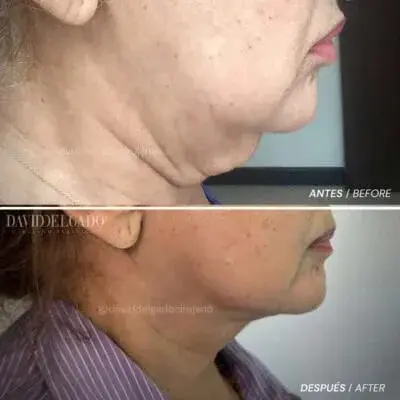
Before-and-after photographs can help a patient understand the range of possible changes, but they cannot determine which technique is appropriate for a different person. Lighting, posture, anatomy, healing and the procedures performed can all affect what appears in an image.
Similarly, names such as “mini neck lift,” “deep neck lift” or “scarless neck lift” can sound attractive online, but they do not provide enough information to make a medical decision. A shorter incision may also produce a more limited correction, depending on the anatomy.
My approach:
I do not begin by fitting the patient into a named technique. I begin by identifying the skin, muscle, fat and facial structures that are creating the concern. The technique comes after the diagnosis.
What Can a Neck Lift in Colombia Actually Improve?
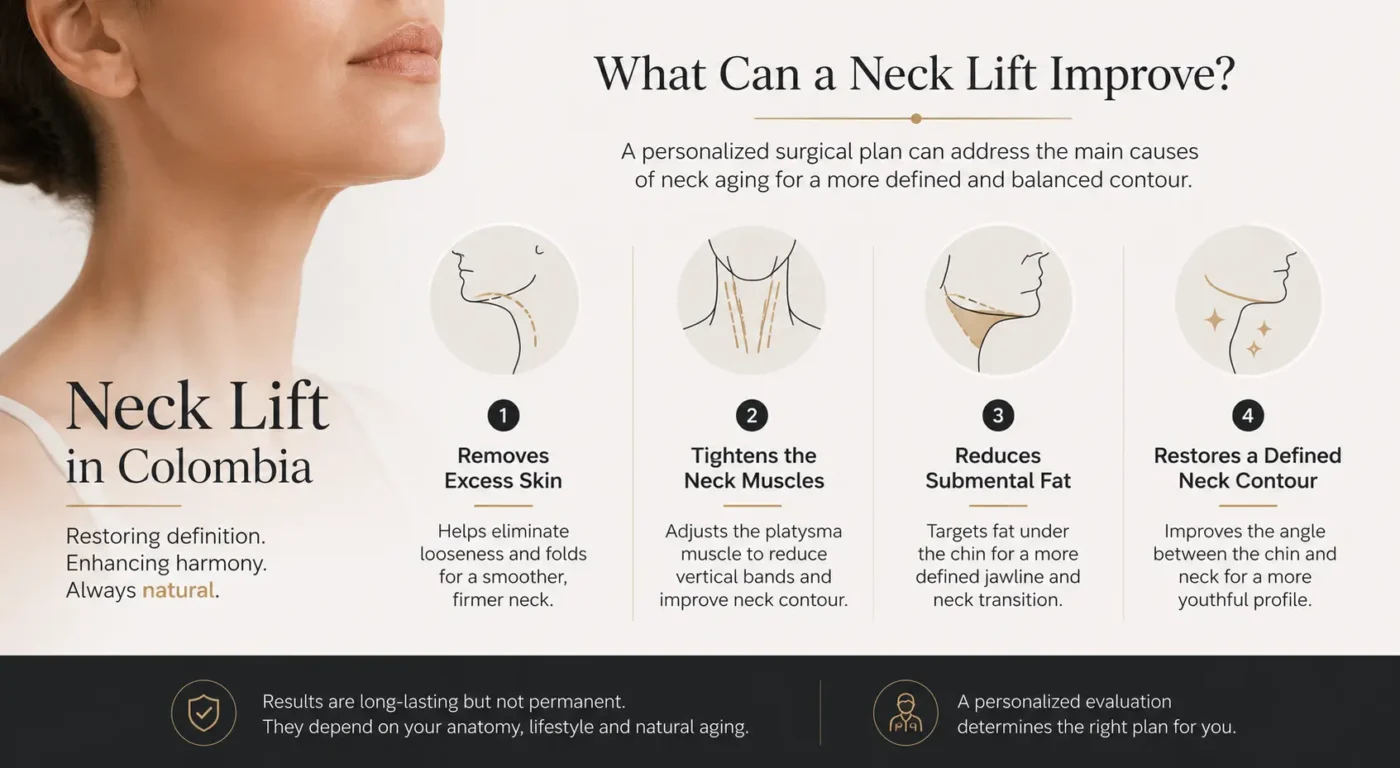
A neck lift in Colombia, also called a lower rhytidectomy, cervicoplasty or, in some contexts, platysmaplasty, is intended to improve visible changes in the neck and jawline. However, these terms do not always describe the same surgical step.
The purpose of the consultation is to determine which tissues need to be treated and how much correction can be achieved without making the neck appear rigid or disconnected from the face.
How Skin, Fat and Muscle May Be Treated in One Surgical Plan
Depending on the anatomy, neck contouring surgery may involve one or more of the following:
- Skin redraping or removal: excess skin may be repositioned and carefully trimmed.
- Platysma adjustment: separated or lax muscle edges may be tightened when they contribute to vertical bands or poor definition.
- Fat contouring: selected fat deposits may be removed, sculpted or redistributed.
- Jawline refinement: the transition between the lower face, jaw and neck may be improved.
- Submental access: an incision beneath the chin may sometimes be used to treat fat or muscle directly.
Not every patient needs every step. Removing too much fat, placing excessive tension on the skin or applying the same technique to all patients can create an unnatural appearance. The surgical plan should preserve adequate tissue support and a smooth transition between anatomical areas.
ASPS describes a traditional neck lift as potentially involving fat contouring, repositioning of underlying tissues, tightening of the platysma and removal of excess skin.
Cervicoplasty and Platysmaplasty Are Not Always the Same Thing
Although these terms are frequently used together, they technically refer to different parts of neck surgery:
| Term | What it generally refers to |
|---|---|
| Cervicoplasty | Treatment and removal of excess neck skin |
| Platysmaplasty | Repair, tightening or repositioning of the platysma muscle |
| Neck lift or lower rhytidectomy | A broader term that may include skin, muscle and fat treatment |
A patient with substantial skin laxity may need cervicoplasty. A patient with prominent vertical bands may require platysma treatment. When both concerns are present, the procedures may be combined.
This distinction matters because tightening skin over an untreated muscle problem may not produce adequate definition. In the same way, repairing the muscle without addressing significant excess skin may leave part of the original concern unresolved.
What Natural-Looking Neck Lift Results Should Preserve
For me, successful natural neck lift results are not defined by making the neck as tight as possible. They are defined by improving the contour while preserving the patient’s identity.
A balanced result should aim to maintain:
- ✔ Natural facial proportions.
- ✔ A smooth transition from the jawline to the neck.
- ✔ Harmony between the chin, lower face and neck.
- ✔ Appropriate softness in the tissues.
- ✔ The patient’s individual facial characteristics.
- ✔ Movement that does not appear restricted or artificial.
The neck should not look as though it belongs to a different face. This is why I evaluate the lower face and jawline even when the patient’s main complaint is located beneath the chin.
What a Neck Lift Cannot Promise
A responsible discussion of neck lift results must also explain the limits of the procedure.
A neck lift cannot:
- ✔ Stop the natural aging process.
- ✔ Guarantee perfect symmetry.
- ✔ Ensure that every scar will become invisible.
- ✔ Guarantee an exact number of years of improvement.
- ✔ Reproduce another patient’s result.
- ✔ Eliminate every line or change in skin texture.
- ✔ Replace healthy habits or appropriate skin care.
The outcome depends on anatomy, surgical technique, skin quality, healing, weight stability, sun exposure and postoperative care. Swelling must also improve before the contour can be evaluated more clearly.
ASPS specifically notes that a neck lift cannot stop aging or fundamentally change a person’s appearance, even though it can improve visible changes in the jawline and neck.
The goal is improvement, not perfection:
I plan a neck lift to create better definition and proportion while respecting the tissues, the face and the natural aging process.

How Much Does a Neck Lift in Colombia Cost?
The reference price for cervicoplasty in my practice is USD 9,000. This gives patients researching neck lift Colombia cost a clear starting point, but price should never be evaluated in isolation. The surgical plan must first reflect what needs to be treated—skin, fat, platysma muscle or a combination of these structures.
Why Neck Lift Prices Vary from One Patient to Another
When patients ask me, “How much does a neck lift cost?”, I explain that the complexity of the procedure can vary considerably. Factors that may influence the final plan include:
- ✔ The amount of excess skin.
- ✔ The presence of platysmal bands.
- ✔ The location and depth of fat.
- ✔ The technique and anesthesia required.
- ✔ The estimated surgical time.
- ✔ The need to combine cervicoplasty with liposuction or another facial procedure.
- ✔ The clinical facility and postoperative care.
For this reason, a general neck lift cost found online may not reflect the treatment another patient needs.
Why the Lowest Quote Is Not Always the Safest Choice
A lower price does not necessarily represent the safest or most appropriate surgical plan. I recommend evaluating the quote together with:
- ✔ The surgeon’s academic and surgical training.
- ✔ Professional certifications and credentials.
- ✔ The accreditation of the surgical facility.
- ✔ The experience of the anesthesia team.
- ✔ Safety and emergency protocols.
- ✔ Postoperative follow-up.
- ✔ The ability to evaluate and manage complications.
A neck lift is an elective procedure, but it remains surgery. Choosing based exclusively on price can leave out factors that directly affect safety, planning and continuity of care.
Colombia May Offer Value, but Safety Should Lead the Decision
The cost of a neck lift abroad may differ from what patients find in their home country. However, I do not believe Colombia should be chosen simply because it appears more affordable.
Its value should come from receiving specialized medical care, surgery in an appropriate clinical environment, personalized planning and structured follow-up. Cost matters, but the surgeon, facility, anesthesia and postoperative support should carry greater weight in the final decision.
Why Choose Dr. David Delgado for a Neck Lift in Colombia?
When I evaluate a patient for a neck lift in Colombia, I do not begin with a standard technique. I study the quality of the skin, the position of the platysma muscle, the amount of fat, the jawline, the chin, the patient’s medical history and the result they hope to achieve. My training at the Universidad Industrial de Santander and the Universidad de Antioquia, together with my affiliation with the SCCP, international membership in The Aesthetic Society (ASAPS) and registration with the Colombian Ministry of Health, supports an approach centered on sound medical judgment, realistic expectations and patient safety.
I see patients from Colombia and abroad at my office in the Oviedo Medical Tower in Medellín, where we can plan the procedure, recovery and follow-up in a personalized way. Surgeries are performed at Interquirófanos, a JCI-accredited facility with established clinical and safety protocols. My goal is not to create an overly tight or artificial neck, but to improve definition while preserving balance between the neck, jawline, chin and face. If you are considering a cervicoplasty, I invite you to schedule an evaluation so we can determine what is causing the change and whether surgery is truly the right option for you.

Frequently Asked Questions About Neck Lift in Colombia
Can a neck lift correct a turkey neck?
A neck lift may improve a turkey neck when the appearance is caused by loose skin, separated platysma muscles, localized fat or a combination of these factors. Depending on the anatomy, I may recommend cervicoplasty, platysmaplasty, fat contouring or several techniques within the same surgical plan. An evaluation is necessary because not every patient with fullness or laxity beneath the chin needs the same procedure.
Is a neck lift the same as cervicoplasty or platysmaplasty?
The terms are related, but they do not mean exactly the same thing. Cervicoplasty generally refers to treating and removing excess neck skin, while platysmaplasty focuses on tightening or repositioning the platysma muscle. A neck lift is a broader term that may include treatment of the skin, muscle and fat, depending on what is creating the loss of definition.
Can I have a neck lift without a full facelift?
Yes, some patients can undergo an isolated neck lift when their main concern is beneath the chin and along the neck. However, when jowls or lower facial laxity are also present, treating only the neck may not create a balanced transition. I evaluate the lower face, jawline, chin and neck together before deciding whether an isolated procedure or a lower face and neck lift would be more appropriate.
How do I know whether I need neck liposuction or a neck lift?
Neck liposuction is generally more suitable for localized fat when the skin still has good elasticity and can adapt to the new contour. A neck lift may be considered when there is significant loose skin, visible platysmal bands or several structural concerns at the same time. Removing fat alone does not repair muscle separation or eliminate a substantial amount of excess skin.
How much does a neck lift cost in Colombia?
The reference price for cervicoplasty in my practice is USD 9,000. The final surgical plan depends on the patient’s anatomy, the technique required, operating time and whether muscle correction, liposuction or another facial procedure is needed. During the evaluation, my team also clarifies which surgical, anesthesia, facility and postoperative services are included in the quote.
How long should I stay in Colombia after neck lift surgery?
There is no single length of stay that is appropriate for every international patient. I consider the procedure performed, the initial healing process, scheduled follow-up appointments and whether drains or sutures require additional management. I recommend planning enough time in Colombia to complete the early postoperative evaluations rather than arranging the return flight for the earliest possible date.
When can I fly home after a neck lift?
Flying should be authorized after an in-person postoperative examination. Before approving travel, I assess the incisions, swelling, mobility, general condition and any symptoms that require observation. International patients should discuss their travel itinerary before surgery and keep some flexibility in case the recovery requires additional follow-up in Medellín.
Where are neck lift scars located?
The position of neck lift scars depends on the technique. Incisions may be placed around the natural contours of the ears, within the hairline or beneath the chin when direct access to fat or the platysma is needed. I plan them in areas that can become less noticeable as they mature, but no responsible surgeon should promise that a scar will be completely invisible.
How long do neck lift results last?
Neck lift results can be long-lasting, but surgery does not stop the natural aging process. Skin quality, genetics, weight stability, sun exposure, lifestyle and postoperative care can influence how the neck changes over time. Instead of promising a specific number of years, I focus on creating a stable, proportionate correction that respects the patient’s anatomy.
What makes someone a good neck lift candidate?
A suitable neck lift candidate is generally in good health, has realistic expectations and is concerned about loose skin, muscle banding, submental fat or reduced neck definition that cannot be adequately treated with superficial options. Age alone does not determine candidacy. I also evaluate skin elasticity, weight stability, nicotine use, previous procedures, healing capacity and the degree of change the patient expects before recommending surgery.
References
- American Society of Plastic Surgeons. (s. f.). Neck lift.
- American Society of Plastic Surgeons. (s. f.). Neck lift procedure steps.
- American Society of Plastic Surgeons. (s. f.). Neck lift recovery.
- American Society of Plastic Surgeons. (s. f.). Neck lift results.
- American Society of Plastic Surgeons. (s. f.). Neck lift cost.
- Pérez, P., & Hohman, M. H. (2023). Neck rejuvenation. En StatPearls. StatPearls Publishing.
- Hatef, D. A., Koshy, J. C., Sandoval, S. E., Echo, A. P., Izaddoost, S. A., & Hollier, L. H. (2009). The submental fat compartment of the neck. Seminars in Plastic Surgery, 23(4), 288–291.
- Fiore, G., Naderi, N., Reed, B., Laird, L. A., & Das-Gupta, R. (2026). A systematic review and meta-analysis of the role of open platysmaplasty in facelift and necklift surgery: Comparative outcomes of closed- vs open-neck rejuvenation with liposuction using FACE-Q scales. Aesthetic Surgery Journal Open Forum, 8, ojag140.