
Yes, surgery can make your face more symmetrical, but the extent of improvement depends on what is causing the asymmetry. Maybe you noticed it in a photo: one cheek looks fuller, your chin sits slightly off-center, or one side of your face simply looks different. As a plastic surgeon, the first thing I explain is that some facial asymmetry is part of normal anatomy. An uneven face does not mean something has to be corrected.
Before talking about face asymmetry surgery, I need to know which structure is causing the difference you see and whether an operation could realistically change it. Some asymmetries need no treatment at all, and some cannot be corrected safely. What I aim for is better facial harmony that keeps your own features. A mirror-image face is not the goal.
Why Does One Side of My Face Look Different from the Other?
A difference between the two sides of your face is usually not a medical problem. It can come from your bone structure, from how facial fat is distributed, or from changes that build up over time.
Is It Normal to Have an Asymmetrical Face?
Yes. Mild facial asymmetry is normal. Our facial bones, muscles, and soft tissues don’t develop as perfect mirror images. One eyebrow may sit slightly higher, one cheek may appear fuller, or the jawline may be more defined on one side.
When I examine a patient, I separate natural variations that need no treatment from more noticeable differences that deserve a closer look. How large the asymmetry is does not, on its own, decide whether surgery makes sense.
What Causes Facial Asymmetry?
There isn’t a single explanation for an uneven face. Some differences are present from childhood, while others develop gradually or appear after an injury.
| Cause | How It Can Affect Facial Symmetry |
|---|---|
| Genetics and natural development | Inherited facial features and differences in how bones and tissues grow can create subtle asymmetries. |
| Bone structure | Differences in the growth or position of the jaw, cheekbones, or chin can affect facial proportions. |
| Aging | Changes in skin elasticity, muscle support, and facial fat distribution can make existing differences more noticeable. |
| Facial injuries | Previous fractures or soft tissue damage may alter facial contours. |
| Medical or congenital conditions | Certain developmental conditions, nerve disorders, or other medical problems can affect facial structure or muscle movement. |
One of the first things I ask is whether the asymmetry has always been there or appeared recently. Sudden facial asymmetry, especially with weakness or difficulty speaking, needs urgent medical care, not a cosmetic consultation.
Uneven Jaw, Cheeks, Chin, or Nose: Where Does Facial Asymmetry Come From?
The location of the difference often provides useful clues, but it doesn’t necessarily reveal the underlying cause.
- Uneven jawline: one side may look wider or more prominent because of differences in bone, muscle volume, or soft tissue.
- Asymmetrical cheeks: one cheek may look fuller because of facial fat, cheekbone projection, or volume lost with age.
- Off-center chin: the chin may look shifted from the center of the face, sometimes because the jaw itself is not aligned.
- Asymmetrical nose: the nasal bones, the cartilage, or the position of the nose can change the balance of the whole face.
Where you see the asymmetry is not always where it starts. A chin that looks uneven, for example, may come from the position of the lower jaw rather than from the chin itself.
So before discussing facial asymmetry correction, I first identify which structures are involved.
Can Face Asymmetry Surgery Really Improve an Uneven Face?
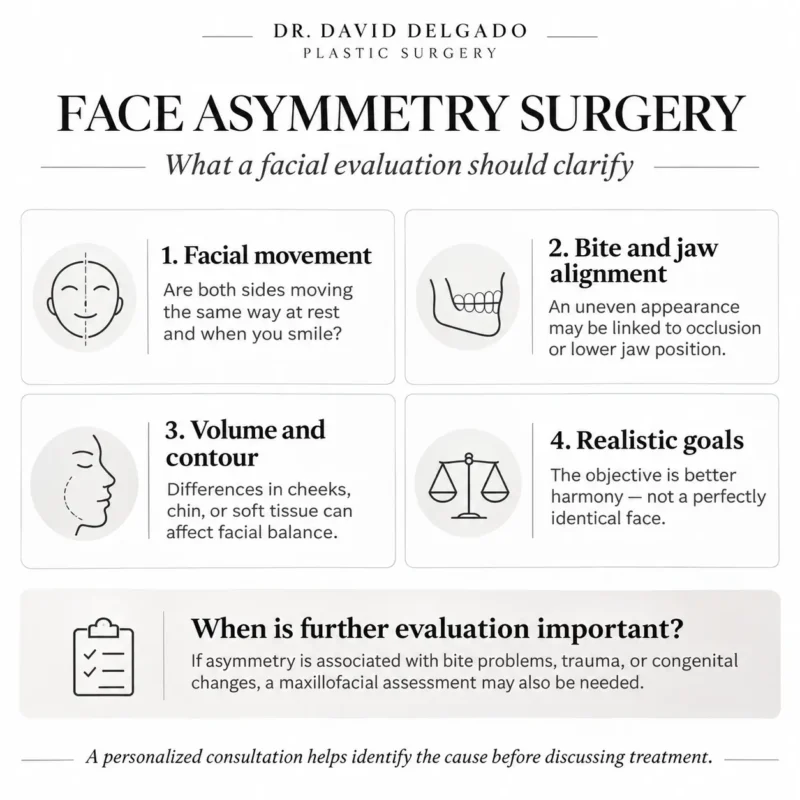
Yes, face asymmetry surgery can improve some differences between the two sides of the face, but how much depends on the structures involved. The step that matters most in my evaluation is working out whether the asymmetry comes from volume, soft tissue, bone, or a mix of them.
What Can Plastic Surgery Change About Facial Asymmetry?
Plastic surgery can change facial contours and the position or volume of some features. Some types of facial asymmetry cannot be corrected with cosmetic surgery alone.
For example, a difference in cheek volume requires a different approach than a chin that appears off-center because of the underlying jaw structure.
With every patient, I work through three questions:
What is causing the visible difference?
The appearance of the face doesn’t always reveal the anatomical origin of the asymmetry.
Can the underlying structures be safely modified?
Some differences may be addressed through aesthetic procedures, while others involve more complex anatomical conditions.
Would the potential improvement be meaningful?
A technically possible adjustment doesn’t automatically mean surgery is necessary or advisable.
Facial Asymmetry Caused by Bone vs. Soft Tissue: Why Does It Matter?
Treatment depends on whether the patient has skeletal facial asymmetry, soft tissue facial asymmetry, or both.
Skeletal asymmetry
Differences in the size, shape, or position of facial bones, including the jaw and chin.
Significant skeletal differences may require specialized evaluation beyond cosmetic facial contouring.
Soft tissue asymmetry
Differences in facial fat, skin, muscles, or other soft tissues.
Certain differences may be suitable for aesthetic procedures, depending on their cause and severity.
Combined asymmetry
Differences involving both the underlying bones and surrounding soft tissues.
Improving only one component may not fully address the visible imbalance.
When Does Facial Asymmetry Require a Different Medical Specialist?
Some asymmetries affect more than appearance. When I find any of the following, the patient may need another specialist’s evaluation.
These cases may need oral and maxillofacial surgeons, orthodontists, or surgeons experienced in complex craniofacial conditions.
Orthognathic surgery, for example, may be considered for some skeletal jaw discrepancies, particularly when they affect dental alignment or function. It is a different operation from cosmetic facial contouring.
Part of my job is to recognize when an aesthetic approach fits and when the patient is better served by another specialist.
Can Facial Asymmetry Be Improved Without Surgery?
In some cases, non-surgical facial asymmetry correction can reduce differences in facial volume or contour.
Injectable treatments are an option for some soft tissue differences. They cannot correct a significant skeletal misalignment.
My view: many asymmetries need no treatment. Sometimes, once we understand where a difference comes from, it is clear that nothing needs to be done.
What Types of Surgery May Help Improve Facial Asymmetry?
There is no single procedure called face asymmetry surgery. The term covers different facial plastic surgery techniques, chosen according to what is causing the asymmetry.
Below are some of the options. They are not interchangeable, and whether one suits you depends on an individual evaluation.
Can Chin Surgery Improve an Uneven or Off-Center Chin?
An asymmetrical chin can make the lower third of the face appear unbalanced, particularly when the chin is positioned slightly to one side or projects differently than expected in relation to the nose and jawline.
In selected patients, genioplasty (chin surgery) can change the position or shape of the chin.
A chin that looks off-center is not necessarily an isolated chin problem. If the asymmetry originates from the position of the entire lower jaw, a different specialist assessment may be required.
Can Rhinoplasty Make an Asymmetrical Nose Look More Balanced?
Because the nose sits in the center of the face, it has a large effect on how symmetrical the face looks.
A rhinoplasty for an asymmetrical nose can address some differences in the nasal bridge, the tip, or the cartilage. How much it improves depends on the anatomy and on what is causing the deviation.
I always evaluate the nose together with the rest of the face. Sometimes a nasal asymmetry looks worse than it is because the chin, jaw, or other facial structures are not perfectly aligned.
The goal of rhinoplasty is not necessarily a perfectly straight-looking nose from every angle, but a more harmonious appearance while respecting nasal function.
Can Facial Fat Grafting Help With Uneven Cheeks?
When one cheek appears fuller than the other, the difference may be related to facial fat distribution, cheekbone projection, or changes associated with aging.
In selected cases, facial fat grafting can reduce a volume difference by moving the patient’s own fat to the side that needs more fullness.
However, this approach has limitations:
- It addresses volume rather than correcting underlying bone position.
- Some transferred fat may be reabsorbed, making the final volume less predictable.
- Adding volume is not always the most appropriate way to improve facial proportions.
So I look at the whole facial structure, not only at the cheek that looks smaller.
What About Uneven Eyelids or Eyebrows?
Differences in eyelid height, brow position, or the amount of visible skin around the eyes can make a face look asymmetrical.
Depending on the cause, the options include blepharoplasty (eyelid surgery) and brow surgery, among others.
But not all differences around the eyes are purely cosmetic. An eyelid that sits lower may be related to ptosis, a condition involving the structures responsible for lifting the upper eyelid.
Changes in muscle or nerve function may also affect the appearance of the eyes and eyebrows.
So I look for the cause before considering surgery, especially when the asymmetry is new or affects vision.
Choosing a procedure should never begin with the question, “Which side should we change?” It should begin with understanding why the difference exists and whether changing it would be safe and worth it.
What Does Medical Research Say About Facial Asymmetry?
Mild facial asymmetry is a normal part of human anatomy, and most differences do not need surgery. In a review published in the Dental Press Journal of Orthodontics, Thiesen et al. (2015) describe mild asymmetry as common and often unnoticed. They recommend evaluating larger differences by their cause, their anatomy, and whether they affect function. That matches what I tell patients: facial balance matters more than perfect symmetry.
Cheong and Lo (2011), in the Chang Gung Medical Journal, start correction from the same question: does the difference come from the skeleton, the soft tissues, or the teeth? They describe a full assessment, with clinical examination and imaging when needed, as the basis for choosing treatment. I follow the same order before discussing face asymmetry surgery with a patient.
Why Choose Dr. David Delgado for a Facial Asymmetry Evaluation in Colombia?
I am a plastic surgeon in Medellín, Colombia, and I see patients at my practice in Oviedo Medical Tower. In a facial asymmetry evaluation I examine your facial proportions, look for the likely cause of the difference, and ask what you would like to change. A difference on its own is not a reason for me to recommend surgery.
Face asymmetry surgery will not make both sides of your face identical. The question is whether specific changes would improve its balance, and the results, risks, and recovery depend on your anatomy and on the procedure. If you live outside Colombia, you can start with a virtual consultation before traveling to Medellín.
If you want to know what applies to your face, schedule a consultation. Surgery may or may not be the answer, and we will decide that together.

Frequently Asked Questions About Face Asymmetry Surgery
1. Can facial asymmetry be completely corrected with surgery?
Face asymmetry surgery can improve certain facial differences, but achieving perfect symmetry is neither realistic nor necessary. Every face has natural variations in bone structure, muscle position, and soft tissue distribution.
What I look for is which differences can be improved safely and whether changing them would actually improve facial balance. The outcome depends on the cause of the asymmetry, the procedure, and your anatomy.
2. Why does my face look more asymmetrical in photos than in the mirror?
Photographs can make facial asymmetry appear more noticeable because of camera angles, lighting, lens distortion, and the distance between your face and the camera. Front-facing smartphone cameras, particularly when used at close range, can exaggerate certain facial proportions.
A mirror also presents a reversed image of your face, which may explain why photographs sometimes look unfamiliar. I would not draw conclusions about your symmetry from a single selfie.
3. Can facial asymmetry get worse as you age?
Yes. Facial asymmetry can become more noticeable with age, even when the underlying differences have existed for many years.
Changes in facial fat, skin elasticity, and soft tissue support don’t always occur identically on both sides. As a result, one cheek may appear less full, or differences around the jawline and eyes may become more visible. However, these changes don’t automatically mean surgical treatment is necessary.
4. Can surgery correct an uneven jawline?
Surgery may improve certain types of jawline asymmetry, but the appropriate approach depends on whether the difference involves bone, muscle, or soft tissue.
For example, an uneven jawline caused by differences in facial volume is not the same as a jaw that has developed in an asymmetric position. Significant skeletal discrepancies, particularly those associated with bite problems, may require evaluation by an oral and maxillofacial surgeon.
5. Is facial asymmetry surgery worth considering for minor differences?
Not necessarily. Mild facial asymmetry is extremely common, and small differences often have little effect on overall facial harmony.
I weigh how noticeable the difference is, whether it causes functional problems, what the patient hopes to achieve, and whether the benefit justifies the risks. Sometimes my recommendation is not to operate.
6. Can facial asymmetry return after surgery?
Some improvements can remain stable for many years, but facial asymmetry surgery does not prevent future changes associated with aging or other biological processes.
The long-term appearance depends on the procedure, tissue healing, underlying anatomy, and changes that occur over time. For example, volume correction using fat grafting may be affected by fat reabsorption, while facial contours can continue evolving as the patient ages.
7. How long does it take to recover from facial asymmetry surgery?
There is no universal recovery period because face asymmetry surgery can involve different procedures.
Some interventions primarily affect soft tissues, while others may involve bone or cartilage. Swelling, bruising, discomfort, and temporary changes in facial appearance may occur during healing.
I explain recovery expectations individually once we have identified the procedure being considered. What you see right after surgery is not the final result: swelling and tissue adaptation take time to settle.
8. Can an uneven face be corrected without surgery?
Certain types of facial asymmetry may be improved with non-surgical treatments, particularly when the difference involves soft tissue volume rather than significant skeletal abnormalities.
Depending on the patient’s anatomy, options such as carefully selected injectable treatments may be considered. However, these approaches have limitations, potential risks, and varying durations of effect. They cannot reposition facial bones or correct major jaw misalignment.
A medical evaluation comes first, to decide whether any treatment is appropriate.
9. How do I know if I need a plastic surgeon or a maxillofacial surgeon?
The most appropriate specialist depends on the underlying cause of your asymmetrical face.
A plastic surgeon may evaluate aesthetic concerns involving facial contours, the nose, or soft tissues. An oral and maxillofacial surgeon may be more appropriate when asymmetry involves significant jaw discrepancies, bite abnormalities, or complex skeletal conditions.
Some patients benefit from a multidisciplinary assessment. If the problem falls outside aesthetic plastic surgery, I refer the patient to the right specialist.
10. Can I have a virtual consultation for facial asymmetry surgery before traveling to Colombia?
Yes. If you’re considering a facial asymmetry evaluation in Colombia, a virtual consultation is a good first step, particularly if you live abroad.
During this initial conversation, we can discuss your concerns, review photographs when appropriate, and explore your expectations. However, photographs and video calls have limitations, especially when assessing bone structure, facial movement, or functional problems.
A virtual consultation can help determine the next steps, but an in-person examination or additional specialist evaluation may still be necessary before making surgical decisions.
References
- Thiesen, G., Gribel, B. F., & Freitas, M. P. M. (2015). Facial asymmetry: a current review. Dental Press Journal of Orthodontics, 20(6), 110-125. PMID 26691977
- Cheong, Y. W., & Lo, L. J. (2011). Facial asymmetry: etiology, evaluation, and management. Chang Gung Medical Journal. PMID 21880188