

Many patients come to my office thinking they simply want more volume in their buttocks, but during the consultation, the real concern is often different: they want their waist, abdomen, lower back, and hips to look more balanced together. That is why fat transfer to the buttocks should not be understood only to make the buttocks bigger. In my experience, this procedure is about reshaping the body using the patient’s own fat to improve proportion, contour, and harmony.
This procedure combines liposuction from selected donor areas with fat grafting to the buttocks, but the result is not defined only by how much fat is transferred. It also depends on how the abdomen, waist, flanks, and lower back are sculpted. I want to explain what is often left out of the conversation about fat transfer from stomach to buttocks: candidacy, safety, realistic expectations, and why sometimes the most beautiful result is not about more volume, but better proportion.
What Does Fat Transfer to the Buttocks Really Mean?
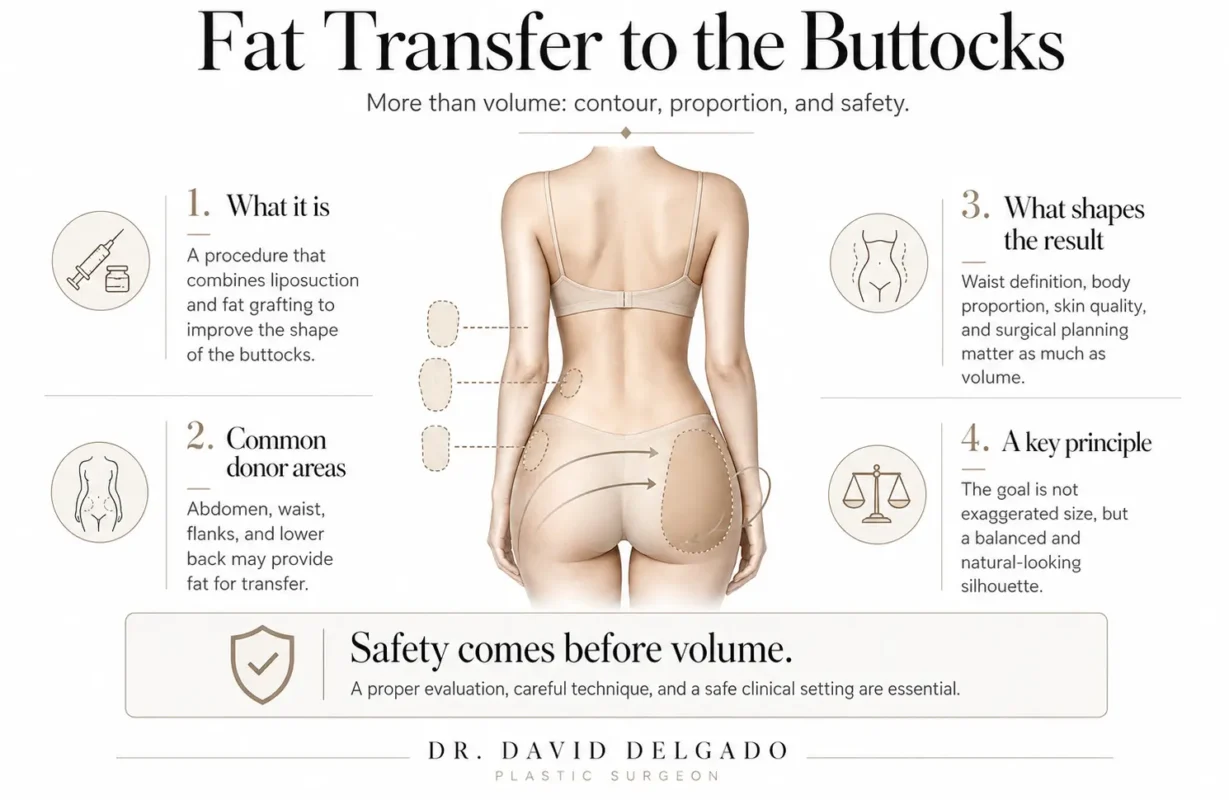
When I talk about fat transfer for buttocks, I am not only referring to increasing volume. Medically, this procedure combines two important steps: removing fat from selected areas through liposuction and then transferring that fat to the buttocks with a clear surgical plan. The goal is not to “fill” the area randomly, but to improve the relationship between the waist, hips, lower back, and gluteal contour.
In other words, fat transfer to the buttocks is a body contouring procedure as much as it is a buttock enhancement procedure. This is an important distinction because the result depends not only on where the fat is placed, but also on how the surrounding areas are sculpted.
It Is Not Just “Adding Fat”: It Is About Redesigning Body Contour
One of the most common misunderstandings about this procedure is thinking that the result depends only on the amount of fat transferred. Adding more fat does not automatically create a better shape.
A well-planned fat transfer to the buttocks considers questions such as:
✔Where does the body need less volume?
✔Where does the body need more projection or softness?
✔How does the waist connect with the hips?
✔How does the lower back transition into the buttocks?
✔What would look natural for this patient’s anatomy?
This is why the liposuction phase is not secondary. Removing fat from the abdomen, waist, flanks, or lower back can significantly change how the buttocks are perceived. Sometimes, the gluteal area looks more defined not because a large amount of fat was transferred, but because the surrounding contour was improved with precision.
Transferred Fat Is Living Tissue, Not an Artificial Filler
Another point I like to explain clearly is that transferred fat is not the same as an implant or a synthetic filler. It is the patient’s own tissue, and that means it behaves biologically.
After the fat is removed, it must be carefully prepared before being transferred. Once placed, part of that fat may integrate with the surrounding tissue, while another part may be naturally reabsorbed by the body. This is one of the reasons why results can vary from one patient to another.
What patients often do not realize is this:
The quality of the result depends on much more than the surgery itself. It also depends on the patient’s anatomy, tissue quality, weight stability, healing process, and postoperative care.
That is why I never evaluate fat transfer for buttocks augmentation as a simple “how much volume do you want?” decision. I evaluate it as a surgical plan that must respect the patient’s body, proportions, and safety.
Why the Abdomen, Waist, and Lower Back Matter as Much as the Buttocks
Many patients ask about transferring fat from the stomach to the buttocks because they feel that their abdomen has extra volume while their buttocks lack projection. In some cases, the abdomen can be a useful donor area, but it is not the only area that matters.
For a balanced result, I usually analyze the body as a whole:
✔The abdomen may influence how flat or defined the front of the torso looks.
✔The waist can create a stronger visual contrast with the hips.
✔The flanks can affect the transition between the torso and buttocks.
✔The lower back can change how lifted or connected the buttocks appear.
This is why fat transfer from stomach to buttocks should not be seen as simply “moving fat from one place to another.” It is a surgical strategy that requires planning, proportion, and medical judgment. The goal is not to create a body that looks operated; the goal is to enhance the silhouette in a way that feels coherent with the patient’s natural anatomy.
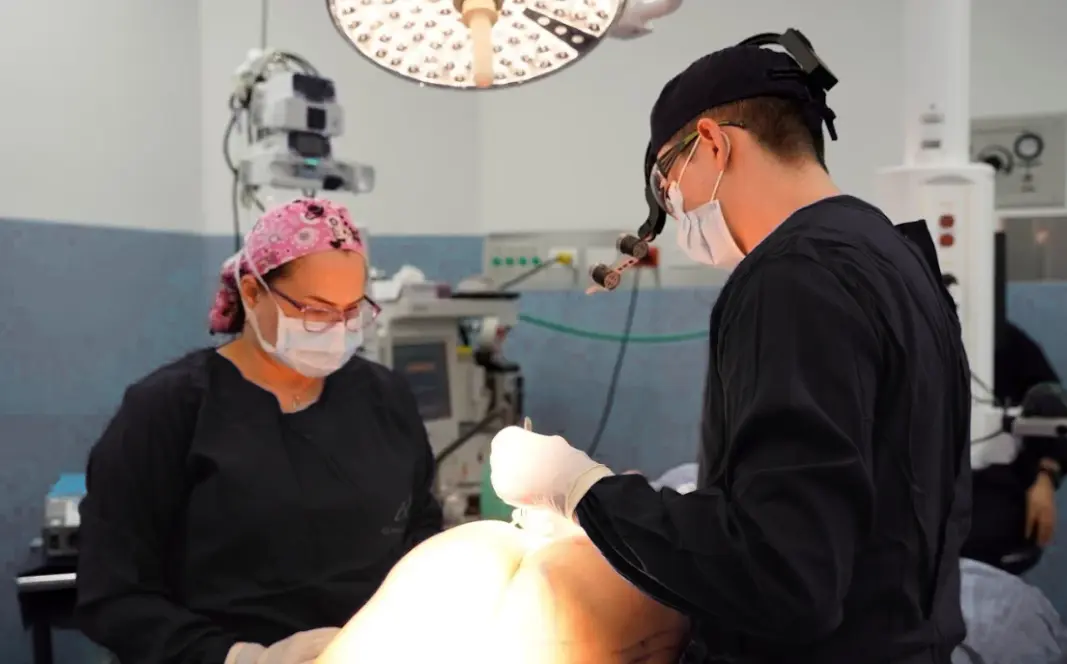
If I Have Fat in My Stomach, Can It Be Used to Improve My Buttocks?
In many cases, the abdomen can be considered a donor area, but the answer is not the same for every patient. Fat transfer from stomach to buttocks depends on several factors: how much fat is available, the quality of the skin, the patient’s anatomy, and whether the body can achieve a balanced result with this approach.
The goal is not simply to remove fat from one area and place it in another. A good surgical plan must consider how the abdomen, waist, hips, lower back, and buttocks work together visually. Sometimes, improving the contour of the abdomen and waist can make the buttocks look more defined, even before thinking about adding a large amount of volume.
Fat Transfer from Stomach to Buttocks: What Many Patients Want to Know
When patients search for fat transfer from stomach to buttocks, they are usually imagining a direct exchange: remove unwanted abdominal fat and use it to create a fuller, more rounded buttock shape. The concept is correct in general terms, but medically, the process is more detailed.
The fat must first be removed through liposuction from selected areas. Then, it is processed and prepared before being transferred to the buttocks. Not all the fat that is removed is suitable for transfer, and not all patients have the same amount of usable fat.
Not All Extracted Fat Can Be Used in the Same Way
One detail that is often left out of the conversation is that extracted fat is not automatically ready to be transferred. During surgery, the fat must be handled carefully because it is living tissue. The quality of that fat, the technique used to process it, and the way it is placed all influence the result.
From a medical perspective, I evaluate several points before deciding how much fat can be used:
✔The amount of fat available in the donor areas.
✔The quality and elasticity of the skin.
✔The natural shape of the buttocks.
✔The patient’s waist-to-hip proportion.
✔The safety of the surgical plan.
✔The patient’s expectations.
This is why two patients who ask for the same procedure may need very different plans. One patient may benefit from a more visible change in the waist, while another may need a more conservative transfer to improve shape without making the result look exaggerated.
What Matters Is Not Only How Much Fat Is Removed, but How It Is Planned
A common misconception is that removing more fat or transferring more fat will always create a better result. More is not always better. The most important part is strategy.
When I plan fat transfer to the buttocks, I am not only thinking about volume. I am thinking about the way light, shadow, and contour will change the silhouette. A more defined waist can make the buttocks appear more projected. A smoother lower back can improve the transition into the gluteal area. A carefully treated abdomen can make the entire torso look more balanced.
That is why planning is so important. The procedure must respect the patient’s anatomy instead of forcing the body into a shape that does not belong to it.
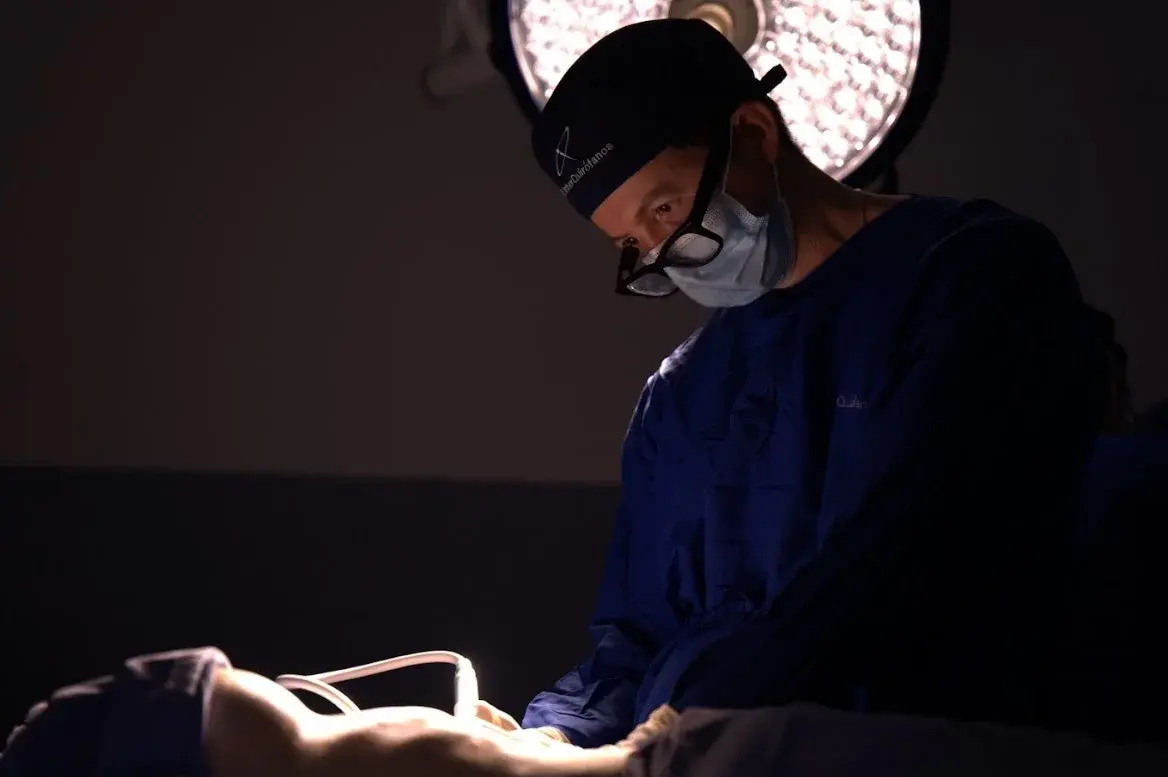
The Result Does Not Depend Only on Buttock Size
Many patients arrive thinking that the main goal is to make the buttocks larger. But in my experience, the most refined results are not always the biggest ones. A beautiful outcome often comes from proportion: the relationship between the waist, hips, lower back, and buttocks.
This is one of the most important ideas I like to explain during consultation: the buttocks do not exist in isolation. Their appearance changes depending on what surrounds them.
The Waist Can Change the Way Buttock Volume Is Perceived
A defined waist can make the buttocks look more prominent even when the amount of transferred fat is moderate. This happens because the eye reads the body through contrast. When the waist is more contoured, the hips and buttocks may appear more balanced and feminine.
In some patients, the biggest improvement does not come from adding a dramatic amount of fat. It comes from improving the waistline and creating a smoother transition between the torso and the gluteal area.
The Lower Back and Flanks Also Shape the Result
The lower back and flanks are essential areas in fat transfer for buttocks augmentation. If these areas are not evaluated properly, the result may look incomplete, even if the buttocks receive fat.
The flanks affect the side contour of the body. The lower back affects how the buttocks transition upward. When these areas are treated with precision, the gluteal region can look more lifted, smoother, and better integrated with the rest of the body.
A Natural Result Is Usually Seen in Proportion, Not Excess
A natural result does not mean a small result. It means a result that looks coherent with the patient’s body. The goal is for the buttocks to look enhanced, but not disconnected from the waist, hips, thighs, or torso.
For me, a balanced result should answer three questions:
✔Does the new contour match the patient’s anatomy?
✔Does the buttock shape look integrated with the waist and hips?
✔Does the result improve the silhouette without looking forced?
This is especially important for patients who bring reference photos. Images can help me understand what they like, but they should not become a fixed promise. Everybody has its own structure, and the safest, most elegant plan is the one that works with that structure.
Fat Transfer from Stomach to Buttocks Without Surgery: A Common Search, but a Misleading Expectation
Many patients search for fat transfer from stomach to buttocks without surgery because the idea sounds appealing: reduce abdominal fat and improve the buttocks without going through an operation. However, it is important to be very clear and honest about this point.
A real fat transfer cannot be performed without surgery. To move fat from the abdomen to the buttocks, the fat must be removed through liposuction, prepared, and then transferred into the gluteal area. That process requires surgical setting, medical planning, anesthesia, and postoperative care.
Can Fat Be Transferred to the Buttocks Without Surgery?
No. If we are speaking about true fat transfer, the answer is no. Fat cannot be moved from the stomach to the buttocks with creams, massages, machines, injections that “relocate” fat, or exercise.
Exercise can strengthen the gluteal muscles. Non-surgical treatments may improve skin quality or firmness in selected cases. But they do not transfer living fat from one part of the body to another.
That distinction matters because patients deserve accurate information before making decisions about their bodies.
What Non-Surgical Treatments Can Improve — and What They Cannot Do
Non-surgical treatments may be useful for certain goals, such as improving mild skin laxity, texture, or firmness. They may also support general body contouring in patients who do not need surgery or are not candidates for it.
However, they cannot do what fat transfer from stomach to buttocks does. They cannot remove a significant amount of abdominal fat, process it, and place it in the buttocks to improve volume or projection.
Here is the clearest way to separate both options:
| If the goal is… | Non-surgical treatments may help | Fat transfer may be considered |
|---|---|---|
| Improve skin texture | Yes, in selected cases | Not the main purpose |
| Increase buttock volume | Limited or no | Yes, if the patient is a candidate |
| Move fat from abdomen to buttocks | No | Yes, surgically |
| Redesign waist-to-hip proportion | Limited | Yes, with liposuction and fat grafting |
Why Clarifying This Point Helps Avoid False Expectations
I believe this clarification is essential because unrealistic expectations can lead patients to choose the wrong treatment. A patient who wants true volume enhancement and body contouring may feel disappointed if they choose a non-surgical option expecting surgical results.
At the same time, not every patient needs surgery. The right decision depends on the patient’s anatomy, goals, health, and willingness to go through recovery.
My role is not to push every patient toward surgery. My role is to explain what is possible, what is safe, and what makes sense for each case.
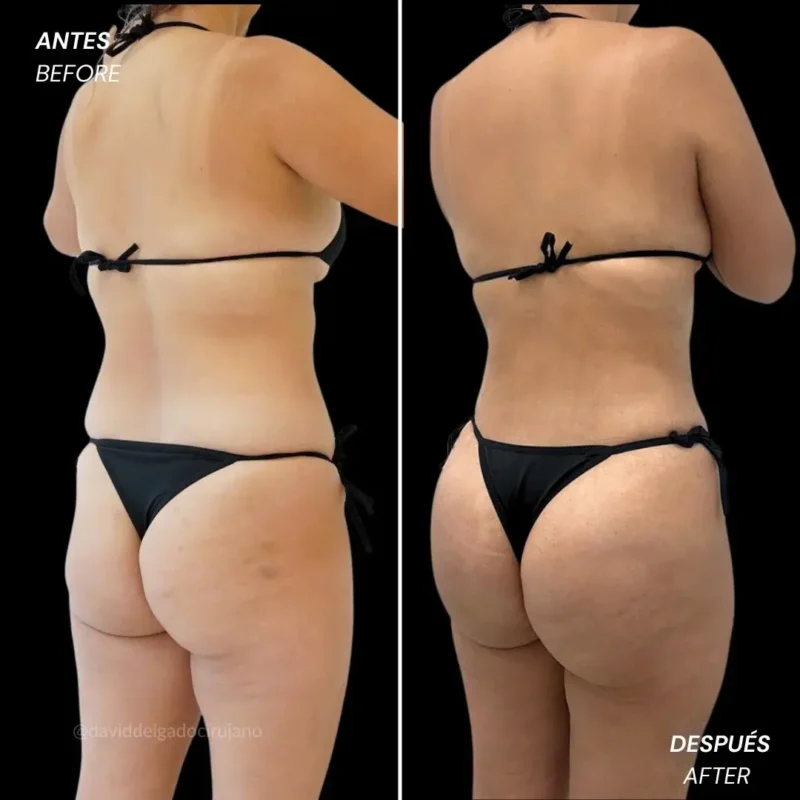
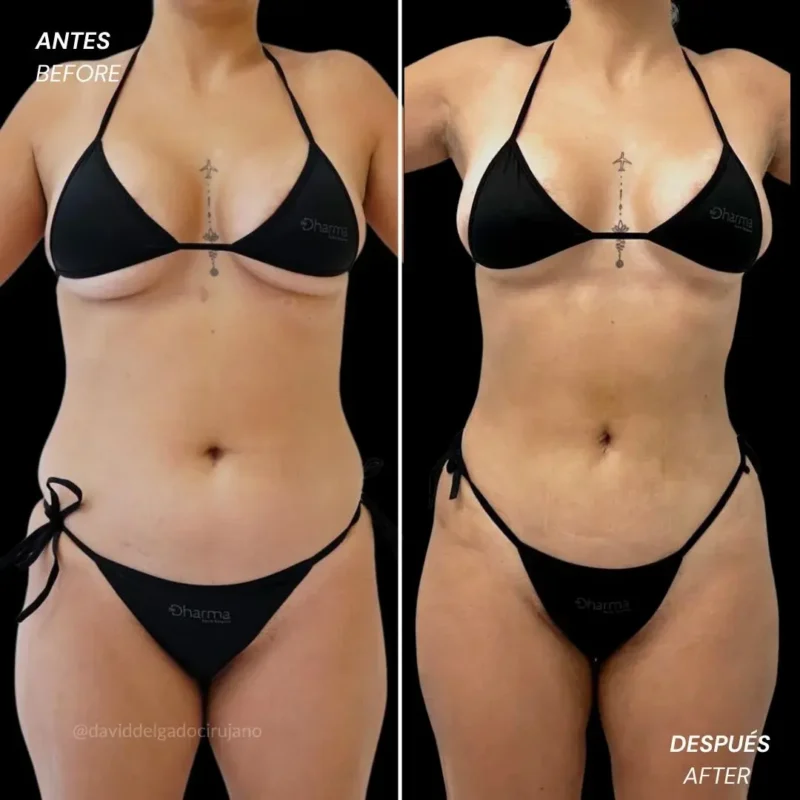
Fat transfer from stomach to buttocks before and after
Safety in Fat Transfer to the Buttocks: The Point That Should Come Before Volume
When patients ask about fat transfer to the buttocks, it is natural for them to think about shape, projection, and contour. However, as a plastic surgeon, I always begin with a different priority: safety. In gluteal fat grafting, safety should never be treated as a secondary detail or something that is discussed only after choosing the desired volume.
A responsible surgical plan must consider where the fat is placed, how much fat is appropriate for the patient’s anatomy, where the fat is harvested from, how the patient will recover, and whether the procedure is being performed in a properly equipped clinical setting. In my practice, volume is never planned separately from safety.
Why the Anatomical Plane Where Fat Is Placed Matters
In fat transfer for buttocks augmentation, the anatomical plane where the fat is placed is one of the most important safety considerations. This is not only a technical detail; it is a central part of responsible surgical planning.
The buttock area has different layers of tissue, and the surgeon must understand them clearly. The goal is not to place fat deeply or aggressively in search of more volume, but to work with a technique that respects the patient’s anatomy and reduces unnecessary risk.
From a patient’s perspective, this means something very practical:
A safer plan is not the one that promises the biggest buttocks. It is the one that respects where fat can be placed responsibly.
This is why I believe patients should ask not only, “How much volume can I get?” but also, “How will safety be handled during my surgery?”
More Volume Does Not Always Mean a Better Result
More volume does not always create a more attractive or more balanced result. In some bodies, too much volume can make the buttocks look disconnected from the waist, hips, thighs, or torso.
When I plan fat transfer to the buttocks, I evaluate the patient’s natural structure first. I look at the width of the hips, the shape of the pelvis, the projection of the buttocks, the lower back, the waist, and the available donor fat. The question is not, “How much can we add?” The question is, “What amount creates a better and safer proportion for this body?”
A helpful way to think about it:
✔A larger buttock is not always a better buttock.
✔A rounder shape is not always achieved by adding more fat.
✔A more balanced silhouette may come from refining the waist and lower back.
✔A surgical plan should improve the body, not force it into a trend.
For me, the best result is one that looks intentional, balanced, and consistent with the patient’s anatomy.
Clinical Safety Starts During Evaluation, Not Only in the Operating Room
Many people think safety begins when the patient enters the operating room. Safety starts much earlier. It begins during the consultation, when I evaluate whether the patient is truly a candidate for surgery.
Before recommending fat transfer for buttocks, I consider several points:
✔General health and medical history.
✔Body mass and available donor fat.
✔Skin quality and tissue behavior.
✔Previous surgeries.
✔Recovery conditions.
✔Ability to follow postoperative instructions.
✔Travel plans, especially for international patients.
This last point is especially important for patients traveling to Medellín. After buttock fat transfer, patients usually need to avoid sitting for long periods during the early recovery phase. That means a long flight too soon after surgery may be uncomfortable and, in many cases, impractical. For this reason, international patients should plan for an appropriate stay in Medellín, not only for the surgery itself, but also for early follow-up and safer recovery logistics.
In my opinion, a good surgical result is not only measured by how the body looks. It is also measured by how carefully the process was planned.
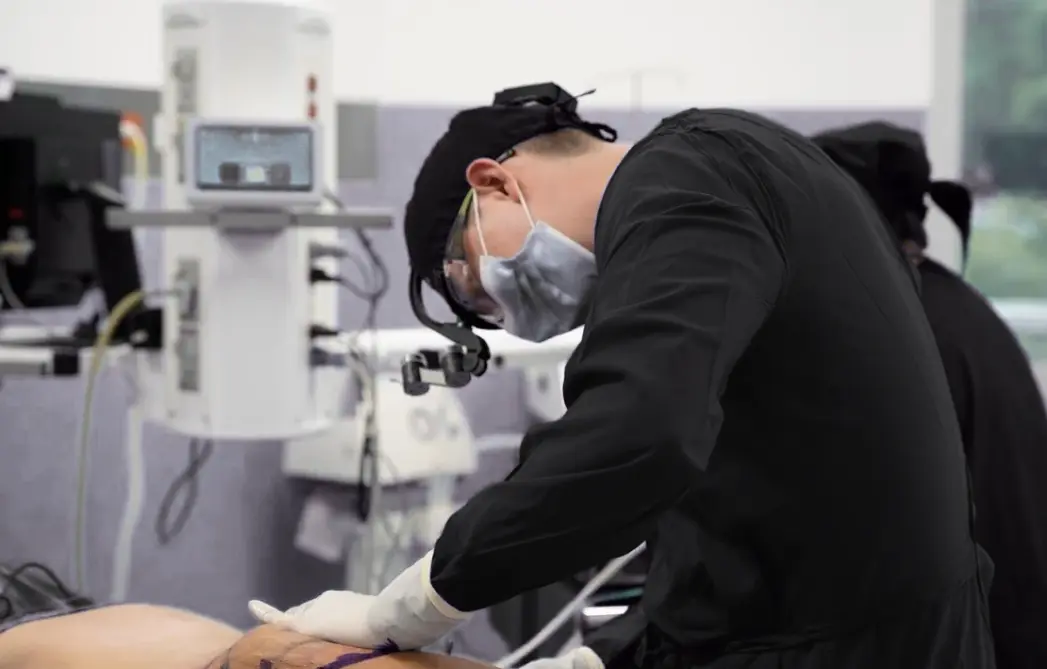
Fat Transfer from Stomach to Buttocks Near Me: What to Consider Before Choosing Where to Have Surgery
When patients search for fat transfer from stomach to buttocks near me, they are usually looking for convenience. They want to know who can perform the procedure close to them or where they can travel to have it done. But with this surgery, location should not be the only factor guiding the decision.
Choosing where to have fat transfer to the buttocks should involve more than distance. It should involve the surgeon’s training, the clinical setting, the safety protocols, the quality of the evaluation, and the follow-up process.
Do Not Look Only for Location; Look for Safety and Medical Experience
Being close to home can be convenient, but convenience should not replace medical judgment. This is especially true for gluteal fat grafting, where planning and technique are essential.
Before choosing a surgeon or clinic, patients should ask:
✔Is the surgeon properly trained in plastic surgery?
✔Is the procedure performed in a safe surgical facility?
✔Is there a qualified anesthesia team?
✔Is the surgical plan personalized?
✔Is the recovery process clearly explained?
✔Is follow-up included?
✔Are the limits and risks discussed honestly?
A serious consultation should make the patient feel informed, not pressured.
What Serious Medical Evaluation Should Include Before Surgery
A proper evaluation for fat transfer for buttocks augmentation should not be limited to looking at photos or asking what size the patient wants. It should include a complete analysis of the body and a realistic conversation about what can be achieved safely.
In my consultations, I evaluate:
✔Donor areas such as the abdomen, waist, flanks, or lower back.
✔Buttock shape and projection.
✔Skin quality and elasticity.
✔Weight stability.
✔Previous procedures.
✔Medical history.
✔Recovery conditions.
✔Expectations and reference images.
Reference images can be useful to understand preferences, but they should never become a promise. The surgical plan must be designed around the patient’s own body.
International Patients: Planning Before Traveling to Medellín
For international patients, Medellín can be an attractive destination for plastic surgery, but traveling for surgery requires responsibility and planning. It is not only about arriving for the procedure and leaving a few days later.
After fat transfer to the buttocks, patients usually need to avoid sitting for extended periods during early recovery. This affects transportation, hotel arrangements, daily movement, follow-up visits, and the timing of the flight back home.
That is why I recommend international patients plan their stay with enough time for:
✔Preoperative evaluation.
✔Surgery.
✔Early recovery.
✔Postoperative follow-up.
✔Safe travel clearance.
✔Assistance during the first days.
A well-planned stay can make the process safer, more organized, and less stressful. Surgery should never be rushed to fit an unrealistic travel schedule.
What Medical Sources Say About Safety in Gluteal Fat Grafting
The safety of fat transfer to the buttocks has been an important topic in plastic surgery societies because this is not a procedure that should be approached only from an aesthetic perspective. The American Society of Plastic Surgeons has emphasized that gluteal fat grafting requires extreme caution and that fat placement should respect safer anatomical planes. For me, this reinforces something I explain to every patient: the goal is not to transfer as much fat as possible, but to design a plan that prioritizes anatomy, proportion, and safety.
Medical literature published in Aesthetic Surgery Journal has also discussed safety considerations in buttock augmentation with fat grafting, including the importance of subcutaneous placement and careful technique. These recommendations are directly connected to the way I approach fat transfer for buttocks augmentation: every decision, from donor area selection to postoperative care, should be guided by medical judgment rather than by volume alone.
Why Choose Dr. David Delgado for Fat Transfer to the Buttocks in Colombia?
When I plan fat transfer to the buttocks, my goal is not to create exaggerated volume, but to design a result that feels balanced with each patient’s waist, hips, lower back, and natural anatomy. I believe this procedure should be approached with medical judgment, careful planning, and honest communication, so the patient understands what is possible, what is safe, and what truly fits their body.
I am a plastic surgeon trained at UIS and Universidad de Antioquia, certified by the SCCP, ASPS, and the Colombian Ministry of Health. My practice is located at Torre Médica de Oviedo in Medellín, and I perform surgeries at Interquirófanos, a JCI-accredited institution. I also work with national and international patients, guiding them through evaluation, surgical planning, recovery logistics, and follow-up with a personalized and responsible approach.
Frequently Asked Questions About Fat Transfer to the Buttocks
What is fat transfer to the buttocks?
Fat transfer to the buttocks is a surgical procedure that uses the patient’s own fat to improve the shape, contour, and projection of the gluteal area. The fat is removed from selected donor areas through liposuction, usually from areas such as the abdomen, waist, flanks, or lower back. Then, it is carefully processed and transferred to the buttocks. The goal is not only to add volume, but to create a more balanced relationship between the waist, hips, and buttocks.
Can fat from the stomach be transferred to the buttocks?
Yes, in suitable patients, fat from the abdomen can be used as part of a fat transfer from stomach to buttocks. However, this depends on the amount of available fat, skin quality, body proportions, and the patient’s overall health. The abdomen is not evaluated in isolation; I also assess the waist, flanks, lower back, and buttock shape to determine whether this approach can create a natural and safe result.
Is fat transfer from stomach to buttocks possible without surgery?
No. A true fat transfer from stomach to buttocks without surgery is not possible. To move fat from one area of the body to another, the fat must be removed through liposuction, prepared, and then injected into the buttocks. Non-surgical treatments may help improve skin texture, firmness, or muscle tone in selected cases, but they cannot transfer living fat from the abdomen to the buttocks.
How do I know if I am a good candidate for fat transfer for buttocks augmentation?
A good candidate for fat transfer for buttocks augmentation usually has enough donor fat, stable weight, good general health, realistic expectations, and the ability to follow postoperative instructions. However, candidacy can only be confirmed through a medical evaluation. During consultation, I assess the donor areas, skin quality, natural buttock shape, medical history, and the type of result the patient wants to achieve.
What happens if I do not have enough fat for the procedure?
If a patient does not have enough donor fat, fat transfer to the buttocks may not be the best option, or the expected change may need to be more conservative. In very thin patients, it may be difficult to obtain enough usable fat to create visible enhancement. In these cases, I explain the limitations clearly and discuss whether another approach, a different goal, or waiting until conditions are more favorable may be more appropriate.
Does fat transfer to the buttocks look natural?
It can look natural when the procedure is planned according to the patient’s anatomy. A natural result depends on proportion, not just volume. The waist, hips, lower back, thighs, and buttocks must look coherent together. In my approach, I avoid planning results that look exaggerated or disconnected from the rest of the body. The goal is to enhance the silhouette while respecting the patient’s natural structure.
How much of the transferred fat stays in the buttocks?
Transferred fat is living tissue, and each body responds differently. A portion of the fat may be naturally reabsorbed during the healing process, while the fat that integrates can remain as part of the patient’s body. The final outcome can be influenced by surgical technique, tissue quality, weight stability, postoperative care, and the patient’s individual healing response. For that reason, I avoid promising an exact percentage or a fixed size.
How should international patients plan their stay in Medellín?
International patients should plan their trip with enough time for evaluation, surgery, early recovery, follow-up, and safe return home. After fat transfer to the buttocks, patients usually need to avoid sitting for long periods during the first stage of recovery. This can affect flights, transportation, lodging, and daily movement. Because long flights require prolonged sitting, the stay in Medellín may need to be longer than some patients initially expect.
What affects fat transfer buttock augmentation cost?
Fat transfer buttock augmentation cost can vary depending on the complexity of the case, the number of areas treated with liposuction, the amount of planning required, operating room and anesthesia fees, postoperative care, garments, follow-up, and travel logistics for patients from other cities or countries. A precise cost should only be discussed after a medical evaluation, because every surgical plan is different.
Why are before and after photos not enough to decide?
Before and after photos can help patients understand possible changes, but they do not replace a personalized medical evaluation. Photos do not show skin quality, donor fat availability, medical history, healing behavior, swelling, fat reabsorption, or the details of the surgical plan. When looking at fat transfer from stomach to buttocks before and after images, it is better to focus on proportion and overall balance rather than only buttock size.
References
- American Society of Plastic Surgeons — Joint Safety Statement
- Practice Advisory on Gluteal Fat Grafting — PubMed
- Kelishadi, S. S., et al. (2024). Accurate Plane Fat Grafting in Gluteal Augmentation. Aesthetic Surgery Journal.